How a Holocaust survivor saved 40 POWs in Korea
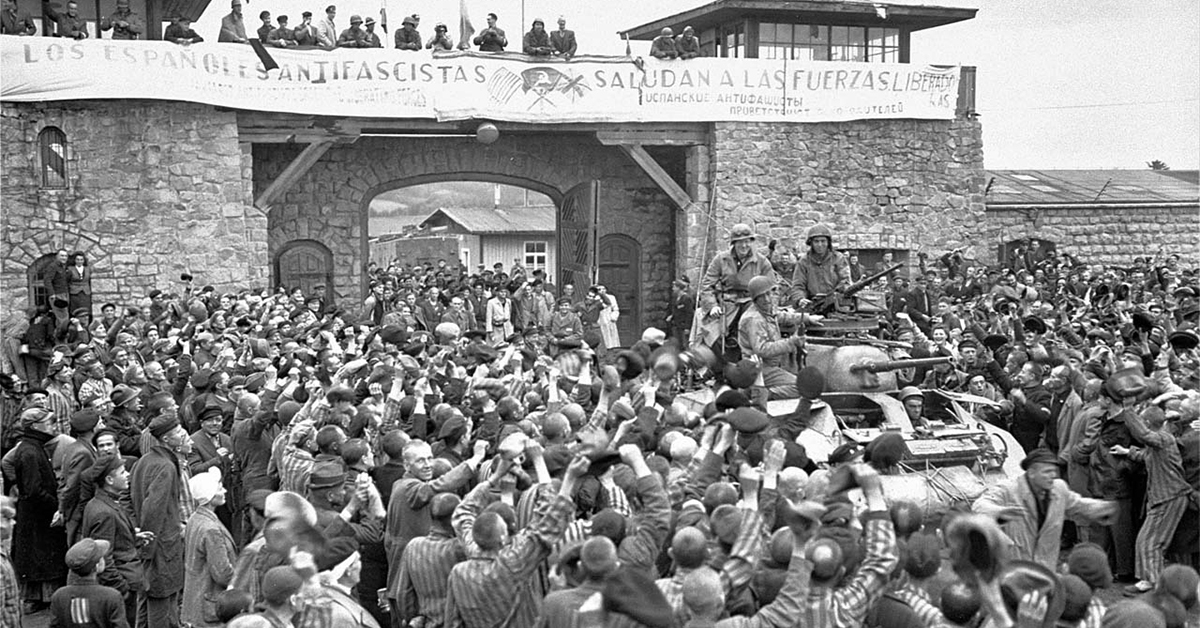
Hunger pangs became a constant, unwelcome companion for Tibor “Ted” Rubin.
The 13-year-old Hungarian boy’s empty stomach wasn’t the worst of it, either. Held in the notorious Mauthausen Concentration Camp (“where murder was a way of life”) in Austria during World War II, Rubin battled disease and ungodly treatment. The conditions were filthy and crowded, and simply surviving became Rubin’s daily mission.
“We had nothing to look forward to but dying,” Rubin recalled.
Many—including some of Rubin’s family members—did not escape the Holocaust. Rubin endured 14 months at Mauthausen and wasn’t sure how much longer he was going to live until the United States Army arrived. The 11th Armored Division liberated Rubin and the other emaciated survivors in May 1945, shortly before V-E Day.
Although severely weakened, Rubin was so grateful to the soldiers who rescued him that he vowed to enlist in the U.S. Army one day.
Joining the Army
After arriving in New York in 1948, Rubin fulfilled that promise.
After flunking the Army entrance exam twice because of his rudimentary English skills, he tried again and finally passed it. Rubin’s military service was nothing short of extraordinary. Part of Company I, 3rd Battalion, 8th Cavalry Regiment, 1st Cavalry Division, Rubin served during the Korean War from July 23, 1950, to April 20, 1953, according to his Medal of Honor citation.
Rubin’s heroism revealed itself first as his unit retreated to the Pusan Perimeter, the citation said. Told to keep an important road open single-handedly so his regiment could escape, Rubin did more than that. He fended out the approaching North Korean forces, feverishly doing whatever he could to outsmart them.
“I ran from one foxhole to the next, throwing hand grenades so the North Koreans would think they were fighting more than one person,” Rubin later told the Army. “I couldn’t think straight. In a situation like that, you become hysterical trying to save your life.”
The rifleman “inflicted a staggering number of casualties on the attacking force,” according to Rubin’s citation. Later on, Rubin was credited with helping detain several hundred enemy troops before he valiantly fought Chinese service members during a nighttime attack in Unsan, North Korea. His heroism came at great personal risk. The Chinese wounded Rubin badly and captured him and other Army soldiers.
Rubin was a prisoner again.
What Made Rubin a Hero
Rubin spent the next 30 months of the war at a camp ominously nicknamed “Death Valley.” At least he had one thing in his favor. He considered his captors, compared to the Nazis, relatively lenient and perhaps not as observant.
Rubin used that to his advantage. Much like he did at Mauthausen—when he surreptitiously picked through garbage for scraps of food—Rubin snuck away in search of nourishment for himself and the other prisoners of war. He broke into supplies of food and raided gardens, taking away as much as he could conceal.
That’s not all Rubin did.
“I once saw him spend the whole night picking lice off a guy who didn’t have the strength to lift his head,” said Sgt. Leo Cormier, another prisoner. “What man would do that? I’d have told him to go down and soak in the cold water so the lice would all fall off. But Ted did things for his fellow men that made him a hero in my book.”
Cormier credited Rubin with saving his life. He wasn’t the only one. Rubin also fed another POW close to death goat droppings and told him they were medicine, the National World War II Museum reported. The severely ill prisoner believed him and recovered.
Perhaps most importantly, Rubin’s uplifting voice encouraged his fellow POWs when there was little reason to hope. Rubin’s Medal of Honor citation credited him with saving the lives of up to 40 prisoners.
Rubin’s captors released him as part of a prisoner exchange in early 1953.
The Long Wait Was Finally Over
Rubin’s path to receiving the Medal of Honor—not for one specific action but rather the totality of his service—was an arduous one.
Other service members put Rubin’s name up for nomination for the U.S. military’s highest award for valor four times. Antisemitism played a role in the rejection of previous nominations. That changed with the 2002 National Defense Authorization Act, which included a provision to review the war records of Jewish and Hispanic American personnel.
Rubin was one of those veterans whose records earned another look. This time, Rubin, who already received the Prisoner of War Medal and two Purple Hearts, was deemed worthy of the Medal of Honor. President George W. Bush presented it to him on September 23, 2005.
It was undoubtedly a proud day for Rubin, but not his proudest. In his mind, nothing beat the moment 52 years earlier when he took the oath to become an American.
“When I became a citizen, it was one of the happiest days in my life,” Rubin said. “I think about the United States, and I am a lucky person to live here. When I came to America, it was the first time I was free.”
Rubin died on December 5, 2015, at the age of 86.
Don’t Miss the Best of We Are The Mighty
• That time Neil Armstrong survived ejecting from his fighter jet in Korea • The combat jumps of the 187th Airborne Regimental Combat Team in Korea • What John Glenn did to save his famous wingman’s life in Korea
Medal of Honor
How a Holocaust survivor saved 40 POWs in Korea
Mighty MilSpouse
The mental health crisis of military-connected families and the system that doesn’t protect us
By Sara Jane Ginn
Why miniguns like the M134 can fire thousands of rounds per minute and not jam
The 5 most important lessons about lethality via historical quotes
Marine Corps and Army Special Forces veteran "Rusty Dusty"
Medal of Honor
Two legendary Vietnam War Marines and a GWOT Green Beret received the Medal of Honor
Related Legacy stories
This American flag survived D-Day, then was returned to the US 75 years later
When Howard Vander Beek died in 2014 at the age of 97, he left behind a distinct reminder of his World War II service. Vander Beek, a lieute
Medal of Honor recipient and legendary Vietnam War helicopter pilot ‘Old Snake’ has died
Retired Army Col. Bruce Perry Crandall, the legendary helicopter pilot who was awarded the U.S. military’s highest decoration for valor for
Air Force crew honors WWII-era Flying Tigers with A-10 paint job
It started as a routine transfer. Following an asset transfer from Korea, maintainers at Moody Air Force Base, Georgia, accepted and process