Iraq and Afghanistan veterans say memorial design is ‘disconnected from the experience’
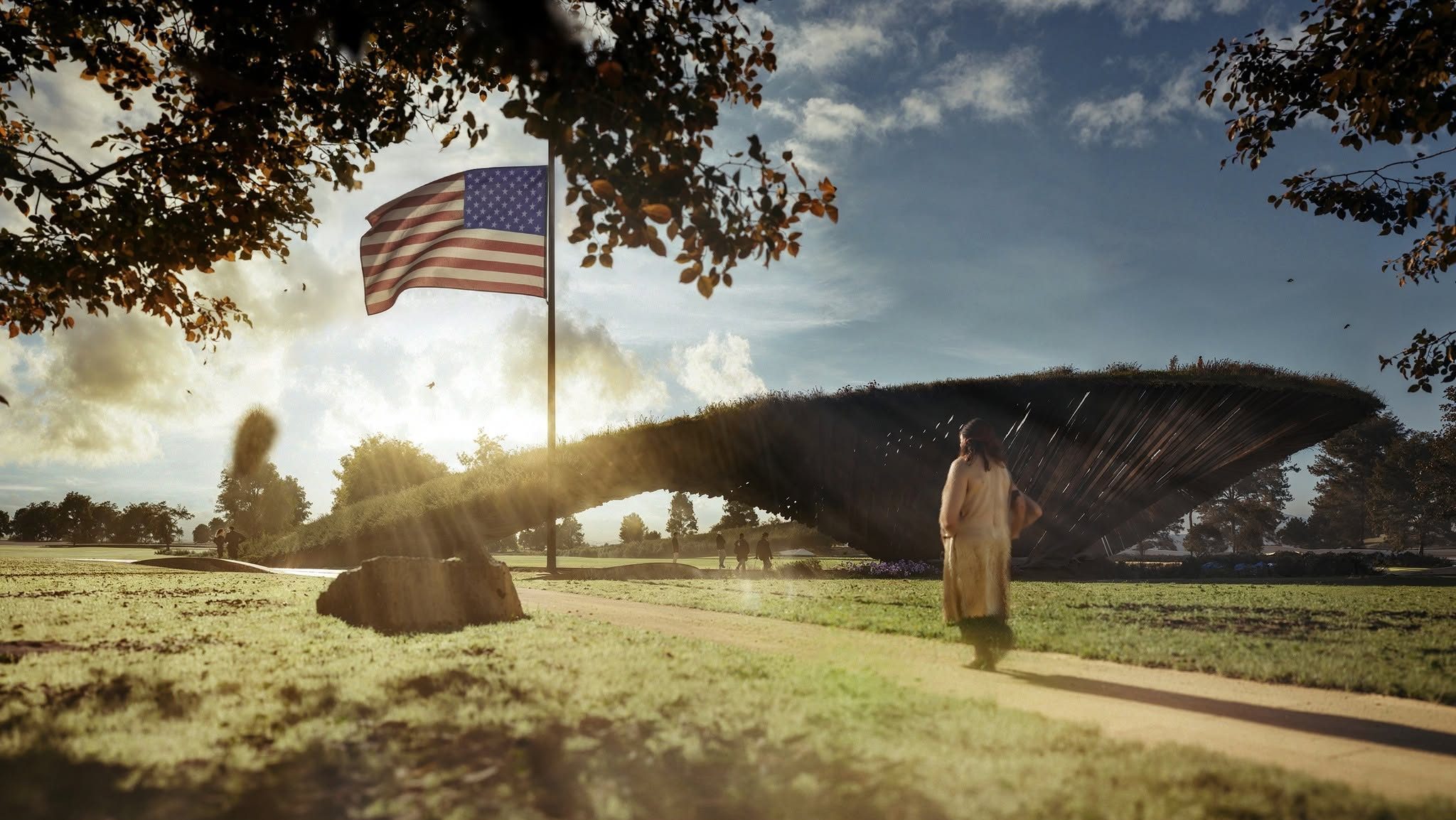
The creators of the future Global War on Terrorism memorial say they based their design around a single question posed to veterans, military families and others associated with the war: How did they want a memorial to the two decades of conflict to make them feel?
This week, after initial plans for the memorial were released — revealing a grass-covered archway and plaza with few direct ties to a battlefield — some veterans, including members of Congress, are questioning whether the design reflected their war
Michael Rodriguez, President of Global War on Terrorism Memorial Foundation. Rodriguez is an Army Special Forces veteran who has been at the forefront of the memorial for most of the last 10 years.
“We’re not any different,” Rodriguez said in a video released by the foundation this week. “We’re your peers. We’re your fellow citizens. I hope people will walk away with a little bit more grace and realize that the blessings that they are enjoying every day, somebody paid for that. Someone else gave for them, and that’s the beauty of our nation.”
But when veterans of that era — which spans not just the wars in Iraq and Afghanistan, but smaller conflicts across the Middle East, Africa, and elsewhere — reacted to the first blush of the plans this week, many said the subdued tone did not reflect their wars.
“It feels disconnected from the experience,” said Alex Plitsas, who led an Army psychological warfare team in Iraq. Now a national security analyst for CNN and the Atlantic Council, Plitsas’ reaction reflected that of many veterans across social media. “It was America’s longest war. It was a global war with a number of theaters with commonalities between them. And there’s no connection to them.”
Designed by Dallas-based architect Kengo Kuma, the plans eschew traditional hard stone or metal statues of traditional war imagery. The memorial is instead a grass-covered arch built over a frame of steel and iron recovered from combat zones. Entrances to the monument will be flanked by wreckage from the attacks of Sept. 11, 2001. A series of engraved footprints carved in marble will pay tribute to families of deployed troops. And the entire structure is oriented toward the section of Arlington National Cemetery, less than a mile away, where many who died in the conflict are now buried.
Plitsas echoed questions posed widely on social media and even by some members of Congress that wondered why the monument did not feature elements more closely connected to the fighting that defined their wars, like concrete barricades known as T-walls, or some display of names or images of the more than 7,000 killed in combat operations that spanned more than a dozen countries.
“Thousands of heroic Americans sacrificed everything in service to our nation during the Global War on Terror,” wrote Indiana Republican Sen. Jim Banks on X. “I served in Afghanistan. These were real people with real stories. They deserve to be honored with dignity, not disconnected abstract art.”
Instead, Plitsas said, the design was a grassy landscaping — largely unknown in the deserts and mountains of Iraq and Afghanistan — focused on families at home.
“I don’t want to diminish families or people who were at home while people were gone a long time,” said Plitsas. “But there’s no real connection to any of the people or the units that were there.”
Dr. Jim Craig has followed the evolution of the GWOT memorial for several years following a 25-year Army career, mostly during that same era. He retired as a lieutenant colonel and now teaches courses on veterans’ issues and war memorials at the University of Missouri-St. Louis.
Top Stories This Week
Event honoring servicewomen canceled after most branches decline to attend
Pentagon cuts 180 faiths from recognized religion list
Rescue mission to remote Atlantic island included rare tandem jump
“I am still ruminating on the design,” he told Task & Purpose. “There are some strong components, which is unsurprising given the architect selected. But I think, at least in the initial drawings, it missed the mark in a few important areas. I understand the desire, but I am less concerned about the lack of design elements that reflect a battlefield than about the lack of elements that encourage new narratives, interpretation, and reinterpretation.”
Craig has written that the GWOT memorial should avoid the mistake of its famous neighbor, the Vietnam Veterans Memorial, widely known simply as The Wall. Though the 1982 monument is considered a masterpiece of war remembrance, its dark, unchanging design may have locked in a public perception of the war that discouraged later generations from reconsidering the conflict. Nearby, newer memorials to women in Vietnam and troops affected by Agent Orange, Craig wrote this year, are overshadowed by the Wall.
But he also said that the Global War on Terror’s lack of a “names of the fallen” roster may have been the correct choice. Over 500 names have been added to the Vietnam War Memorial since it was first erected, for reasons varying from paperwork mistakes to eligibility controversies, while other groups continue to fight for inclusion, including 74 sailors killed in a naval accident outside the war’s boundaries.
The many small operations covered under the GWOT name could make selection even more difficult.
“Lists of the fallen are popular these days,” he said. “But curating such a list is a significant and fraught task. It may be better not to have it than get it wrong.”
Michele Bogart, a professor emeritus of art history and visual culture at Stony Brook University, has also written extensively on war memorials in U.S. history.
“To me the question is whether the GWOT vets don’t care for the design because it’s overblown and abstract, lacking the kind of figurative soldier statues that are a signature of many of the war memorials on the mall and elsewhere, or whether the problem is something else,” Bogart told Task & Purpose. “This new GWOT design looks attractive as landscape design, but perhaps the veterans don’t feel like it really has much to say about them, and the lives that were lost.”
According to the foundation’s website, construction on the memorial is expected to begin in earnest in 2027. The same day it introduced the plans, the group’s website posted a public survey to collect feedback on the design.
Related Legacy stories
This American flag survived D-Day, then was returned to the US 75 years later
When Howard Vander Beek died in 2014 at the age of 97, he left behind a distinct reminder of his World War II service. Vander Beek, a lieute
Medal of Honor recipient and legendary Vietnam War helicopter pilot ‘Old Snake’ has died
Retired Army Col. Bruce Perry Crandall, the legendary helicopter pilot who was awarded the U.S. military’s highest decoration for valor for
Air Force crew honors WWII-era Flying Tigers with A-10 paint job
It started as a routine transfer. Following an asset transfer from Korea, maintainers at Moody Air Force Base, Georgia, accepted and process