One mission, new frontier: Shaping space exploration and Veteran care

Veterans are helping power America’s return to deep space—and the Department of Veterans Affairs (VA) is supporting them every step of the way. From Artemis II astronauts and engineers to VA researchers studying how space affects the human body, Veterans continue serving in ways that advance both exploration and medicine.
Veterans at the center of Artemis II
As space exploration accelerates, Veterans remain at its core. Across NASA, many astronauts, engineers and mission support specialists bring military experience shaped by high-pressure, mission-focused environments where teamwork, precision and accountability are critical.
NASA’s historic Artemis II mission—the first crewed trip to the moon since 1972—reflects that legacy of service. Led by Veterans like Commander Reid Wiseman and Navy pilot Victor Glover, the mission is supported by a broad team behind the scenes, many of whom also served in the military.
“Something greater than ourselves”
For many Veterans, working at NASA feels like a natural continuation of service.
Marine Corps Veteran Yves Lamothe, now a senior project manager for communications systems within Exploration Ground Systems, describes his work as an honor: “I’m proud to have been part of many of the teams that I have had the opportunity to work with throughout my military career and at NASA.”
For Marine Corps Veteran Carlos Monge, who leads Test, Launch and Recovery Operations management, the connection is deeply personal. His work reflects the same motivation that led him to serve in the first place—a commitment to something bigger than himself. As Monge explains, his team members “are truly dedicated to the mission and we believe in it,” a mindset that, for him, comes down to a simple truth: “for me, its the love of the mission.”
Air Force Veteran Lisa Barber found her path through a moment of inspiration. After leaving active duty, she watched a shuttle launch and as she recalls, “It was just the excitement with everybody seeing that launch happen,” which sparked a realization: “Hey, I live here now—maybe there’s an opportunity for me to be part of something as monumental and exciting as the space program.” Today, she helps lead program planning and control for Exploration Ground Systems.
Former Air Force officer Alessa Makuch, now a NASA test director for the Exploration Ground Systems Program, found a natural continuation of her service-driven mindset at NASA. “It was a natural transition to continuing working with amazing people as a team working for something that’s greater than ourselves.”
Together, their stories share a common theme: The mission didn’t end after military service—it evolved.
Support after service
Continuing that mission in civilian life often requires the right support, including education, healthcare and stability. Many Veterans credit VA benefits with helping them make that transition.
Lamothe believes industries like space exploration need exactly what Veterans bring: leadership, discipline and a mission-first mindset. As he put it, service “doesn’t stop when you take that uniform off.”
He used the G.I. Bill to earn his degree and VA home loans to build stability. Reflecting on his experience, he says, “I have been fortunate to use some of the benefits that come along with being a Veteran.” He sees VA as a support system that helps Veterans move forward and encourages others to take advantage of VA resources.
Makuch also credits these programs with helping her transition with confidence and build a new path after military service. As she explained, “VA made the process for applying to use the G.I. Bill benefits and then the ability to just have them pay the school directly was very easy,” highlighting how accessible support systems can make a meaningful difference for Veterans pursuing education.
For Barber, VA healthcare has provided accessible, responsive care and supportive providers who seem genuinely focused on helping. “My experience has been wonderful. I think everyone that works there, they’re just wanting to help.”
Monge describes a similarly positive experience during the disability claims process, noting that the clear communication, timely appointments, and professional staff made it “a lot easier than I thought it was going to be.”
These resources help Veterans continue contributing their skills in fields like space exploration, where leadership and mission focus remain essential.
Advancing care through space research
The connection between NASA and VA extends beyond careers and transition support. Research conducted in space is also helping improve care for Veterans here on Earth.
VA is not only a healthcare provider but also a leader in medical research and innovation. Working with partners like NASA, VA researchers study how extreme environments affect the human body, leading to new treatments and technologies.
This work also extends to understanding the environmental exposures Veterans face during deployment. Through the Service and Health Among Deployed Veterans (SHADE) study, part of the VA Cooperative Studies Program, researchers are using publicly available NASA satellite data to identify and estimate military exposure levels among Veterans who served in Afghanistan, Iraq and other regions across Central and Southwest Asia and Africa (Djibouti). By combining space-based data with health research, the study aims to give clinicians, researchers and policymakers a clearer picture of how deployment conditions and environmental exposures influence long-term Veteran health.
This work builds on decades of progress. One pioneering figure, Millie Hughes-Fulford, Ph.D., a VA scientist and NASA astronaut, conducted biomedical research during a 1991 space shuttle mission. Her studies on bone loss and immune system changes in space shaped decades of discoveries that continue to influence research today.
Now, researchers across VA are expanding on that legacy.
At VA Palo Alto, biomedical engineer Ngan F. Huang, Ph.D., and her team are studying muscle loss by sending engineered tissue to the International Space Station (ISS). Because microgravity accelerates muscle deterioration, it allows researchers to test potential treatments for age-related muscle loss—ultimately helping Veterans improve long-term mobility.
At Central Virginia VA, Robert Adler, MD, chief of endocrinology and metabolism, is advancing bone health research using an innovative MRI technique to detect early bone loss in patients with spinal cord injuries. This condition mirrors the rapid bone loss seen in astronauts, which increases fracture risk. If successful, this approach could offer a safer way to monitor bone health without additional radiation exposure.
Across VA, researchers are leveraging space-based studies to better understand the human body and improve long-term health outcomes.
The mission continues
Whether advancing space exploration or improving care on Earth, Veterans continue to serve in meaningful ways long after their military careers end.
VA remains committed to supporting that ongoing mission through healthcare, education, benefits, research and career opportunities that help Veterans build strong futures.
Learn more about VA Research.
Explore transition programs.
Discover careers at NASA.
Explore VA careers.
Related Health stories
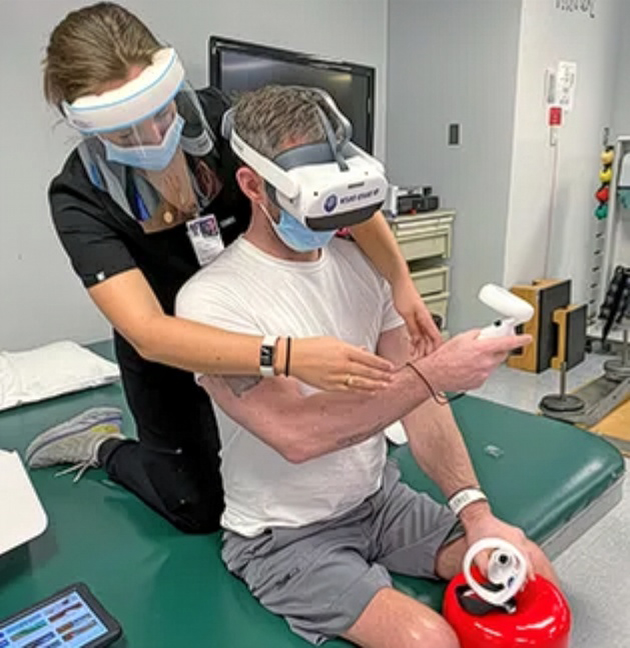
Virtual reality pain treatment expands for veterans
The Department of Veterans Affairs is expanding access to a U.S. Food and Drug Administration-authorized virtual reality (VR) therapy design

Live Whole Health #320: You deserve a break
Do you spend hours jumping between screens, messages and tasks during the day? Over time, this can make your mind tired and your body stiff.

First in VA to receive cutting-edge epilepsy treatment
A groundbreaking laser procedure offers a safer option for epilepsy treatment Back in 1980, when Robert Lindemann decided to enlist in the A