Spinal Cord Injury team helps Army Vet keep competing

Strength, perseverance and the power of SCI rehabilitation
Army Veteran Mark Maloney suffered a spinal cord injury after falling off his bike six years ago. The resulting fall broke his neck, paralyzing him.
Maloney, now 90, had run marathons, competed in the Pikes Peak Ascent race in Colorado Springs, and had been a competitive runner for decades. He was physically active, out in the community, constantly challenging himself; all of that changed with just one fall.
After several years of painstaking rehabilitation and care with the Spinal Cord Injury (SCI) department at the Rocky Mountain Regional (RMR) VA Medical Center in Aurora, Maloney is back to doing what he loves: competing.
“I feel fantastic,” said Maloney. “When I was there, I wasn’t sure I’d be able to get out of bed. I didn’t know whether I’d be able to taste food again. I was unclear of my future, but the physical therapists got me out of bed, and it was a long process but eventually they helped me learn how to swallow food again.”
Maloney’s injury resulted in what is classified as C3 incomplete spinal cord injury, meaning his spinal cord injury starts at his C3 vertebrae.
“It’s really high (on the spinal cord) for any injury,” said Liam Kiernan, VA Eastern Colorado Health Care System (ECHCS) clinical specialist and physical therapist. “So, it has a big effect on his whole body. So, in his instance, there is a lot of dysfunctions with hands, trouble breathing, and goes all the way down to his legs. ‘Incomplete’ means there are some signals that are making it through the spinal cord down to his legs. If he was complete, he’d be on a ventilator, even more impaired than he is now. So, incomplete is generally a good thing.”
Though an incomplete spinal injury is better than a complete spinal cord injury, Maloney still had challenges he overcame to get to where he is now. And now, he is able to take part in races, such as the Bolder Boulder race that happened on May 25.
The SCI team at RMR helped him adjust to his new circumstances, working with Maloney to get back as many functions as possible.
“I had to pass tests to enable me to do that,” said Maloney. “I was able to eat food again and taste it rather than have a tube going into my stomach. So, even though I only stayed there for three months, they provided me with some exercise equipment, and I’ve been an outpatient now for almost five years. I’m a big advocate of VA.”
Finding purpose in helping other Veterans
During that time, going through inpatient care, Maloney worked with other Veterans who suffered spinal cord injuries, and to them he served as an empathetic ear, confidante and resource.
“When I arrived there, I didn’t know what questions to ask. I wasn’t in a clear state of mind,” he shared. “And what I’m doing now, I don’t do it as often as I would like, but when I have the opportunity, I go up and talk to either Veterans who have just arrived or who are just leaving. So, maybe I can answer the questions they might have in both cases.”
Kiernan echoed that sentiment.
“I think it means a ton,” said Kiernan. “This Veteran had a similar injury, and he was coming to terms with the fact life will never be the same, and his conversation with Mark gave him a little bit of hope.”
When recovering from such severe injuries, having a goal to motivate oneself is especially important. Maloney’s goal was to continue racing.
Motivation through racing
“I’ve been a competitive runner since the age of 55,” said Maloney. “I’ve ran marathons, triathlons. I’ve won in my age group. Hopefully, I’ll be able to make the one kilometer into the football stadium at Boulder. If I do make it to the end, it’s going to be tough. Probably one of the toughest things I’ve ever done.”
This type of motivation helps in the recovery process for those at the SCI Clinic as well. It helps them not only recover but come to terms with and cope with their current situation.
“With any Veterans, we try to find things for the Veterans they have an interest in, and a love for, to help them,” said Kiernan. “It’s important for Veterans to have a goal that has them physically active as possible.”
Maloney’s recovery hasn’t just been the individual effort of just one member. It has been a team process that has helped to get him to where he is today.
A team approach to recovery
“He has three or four different therapists,” said Kiernan. “Different people take turns working with him, a bunch of other physical therapists and occupational therapists who have worked with him to help him recover. I’ve worked with him for the past three or four years, working on his strength, balance. Between the three of us, we’ve gotten him to where he is today.”
Continuing to inspire others
With help from RMR SCI department, Maloney was able to compete in the Bolder Boulder, inspiring other Veterans who may be going through a similar situation.
“I’m hoping I can do and show others that if a 90-year-old guy can do it, maybe they can. I ran the race a few times before my accident. I (ran) in my age group. This will be another nice achievement for me. Not too long ago I was on the front page of the Colorado Springs Gazette, talking about what VA has done to help me. And I take any opportunity, like this one, to indicate that the support I have received from VA over the past five years has been outstanding.”
Find out about VA’s Spinal Cord Injuries and Disorders System of Care.
Related Health stories
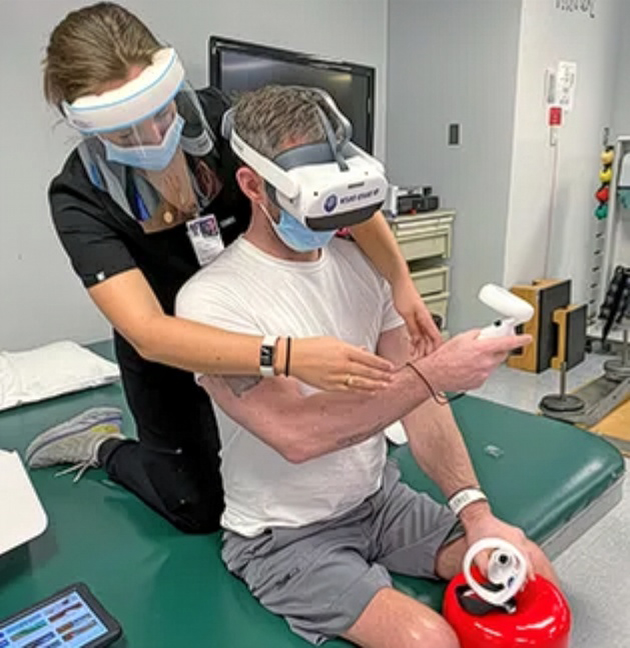
Virtual reality pain treatment expands for veterans
The Department of Veterans Affairs is expanding access to a U.S. Food and Drug Administration-authorized virtual reality (VR) therapy design

Live Whole Health #320: You deserve a break
Do you spend hours jumping between screens, messages and tasks during the day? Over time, this can make your mind tired and your body stiff.

First in VA to receive cutting-edge epilepsy treatment
A groundbreaking laser procedure offers a safer option for epilepsy treatment Back in 1980, when Robert Lindemann decided to enlist in the A