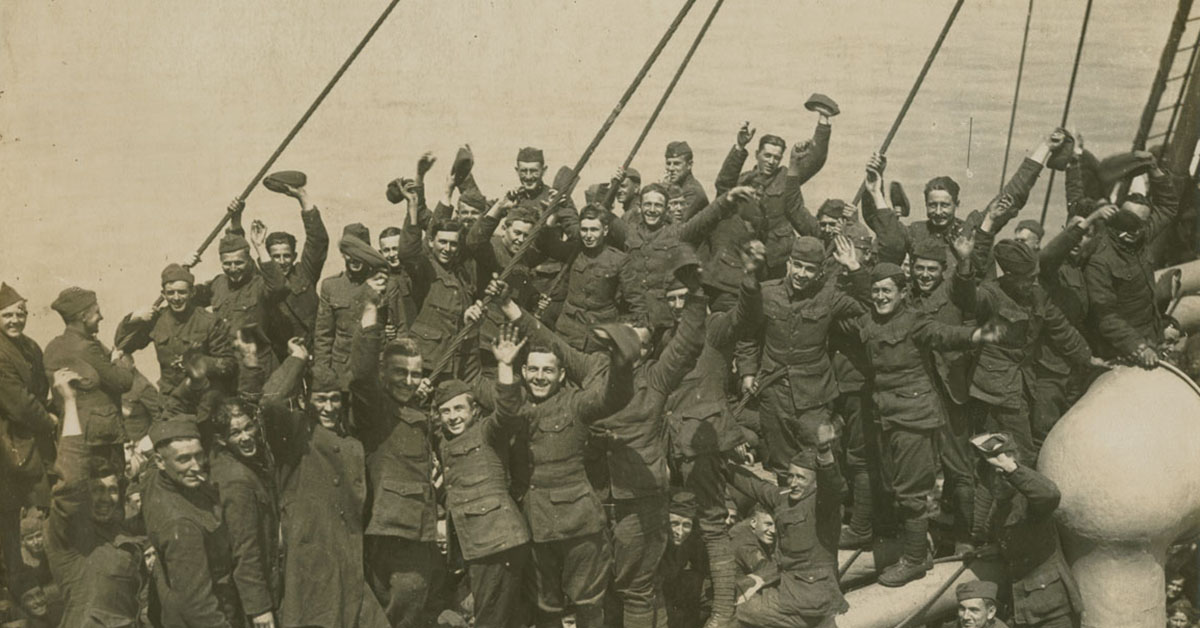
The ‘Iron Division’ of World War I came from the Pennsylvania National Guard
In major conflicts throughout American history, the lines are blurred between who did what and when. Unless someone decides to “Stephen Ambrose” your unit, any action or glory is usually reduced to a paragraph in a history book or a vaguely accurate sentence on Wikipedia.
The National Guard’s exploits get reduced to a negative stereotype. While it may not be all inaccuracies or embellishments of reality, the majority of National Guard history gets rolled in with everyone else’s.
When someone mentions the 28th Infantry Division, you may automatically assume they’re active duty. But the reality is that they’re the Pennsylvania National Guard’s Keystone Division, and it’s time to put some respect on their name.
The Oldest Division in the Army
The 28th Infantry Division traces its lineage all the way back to Benjamin Franklin’s battalion, the Pennsylvania Associators, as part of the larger Associators formation in 1747. The Associators were militias who were exempt from regular mandatory military service. They officially organized as the 28th ID in 1917, when the United States entered World War I, and deployed to the front in July 1918.
A German assault began what became known as the Battle of Chateau-Thierry and eventually turned to hand-to-hand combat. The 28th ID held the line and successfully repelled the Germans. During the battle, four companies from the 109th and 110th Infantry sustained heavy losses. Gen. John Pershing, the commander of the American Expeditionary Forces, visited after the battle and declared the 28th “Men of Iron” and dubbed them his “Iron Division.”
The division went on to fight in the Meuse-Argonne offensive and the Second Battle of the Marne. Overall, the 28th sustained more than 14,000 casualties, with over 2,000 service members dying. They returned to the United States in April 1919 and refocused their efforts on training.
World War II
Seven weeks after the D-Day landings, the 28th arrived in France. After the men landed, they joined Lt. Gen. Omar Bradley’s Operation Cobra, the campaign to break through the German defenses in France. The division fought through the French countryside and pushed east until reaching Paris, where it participated in the Liberation of Paris victory parade. The men were then assigned to the German Westwall.
Upon arriving at the Westwall, the division immediately got to work. It first sent a night patrol from the 109th Infantry, which crossed Our River and became the first unit of the Allies to reach German soil. The unit continued to struggle, suffering heavy casualties during the Battle of Hürtgen Forest. That battle turned into the longest continuous battle the U.S. Army fought during World War II.
By the end of the war, the 28th had seen 196 days of combat. They suffered more than 16,000 casualties, including 2,000-plus deaths. More than 9,000 sustained wounds, 884 were missing in action, and nearly 4,000 were prisoners of war. One soldier, Francis J. Clark, earned the Medal of Honor.
Additionally, the unit earned 29 Distinguished Service Crosses, 435 Silver Stars, and more than 2,000 Bronze Stars.
The National Guard’s involvement in the Global War on Terror is mostly underrated, and the 28th ID is no different. While it may not get a lot of credit, the 28th was largely responsible for the Ramadi region of Iraq in 2006. The 3rd Battalion, 8th Marine Regiment and 1st Battalion, 506th Infantry were attached to the division before the 1st Armored Division ultimately relieved them in June.
During its time in Ramadi, the division suffered 82 killed and 611 wounded. It incurred an average of 20 attacks per day. Since then, the division has deployed numerous times in Iraq, Afghanistan, and other missions around the globe.
The 28th Infantry Division fought hard through two world wars and has served with honor during the GWOT era. The Pennsylvania World War Memorial in Varennes-en-Argonne, France, honors its service during WWI. The soldiers serving with the Red Keystone patch on their shoulders show up when their communities—or their country—need them. They carry on the 28th Infantry Division’s legacy.
Don’t Miss the Best of We Are The Mighty
• The National Guard unit that stormed Omaha Beach on D-Day • Why the National Guard is a great option for Marines • The National Guard’s ‘one weekend a month, two weeks a year’ slogan is outdated
The ‘Iron Division’ of World War I came from the Pennsylvania National Guard
This National Guard unit fought alongside Marine Raiders in the Pacific
World War II
The story of the only US soldier executed for desertion since the Civil War
Hollywood can bridge the divide between civilians and the military. It doesn’t.
A new veterans bill includes Major Richard Star Act but cuts benefits for 1.5 million to fund it