JFK’s words of wisdom to the military leaders of tomorrow
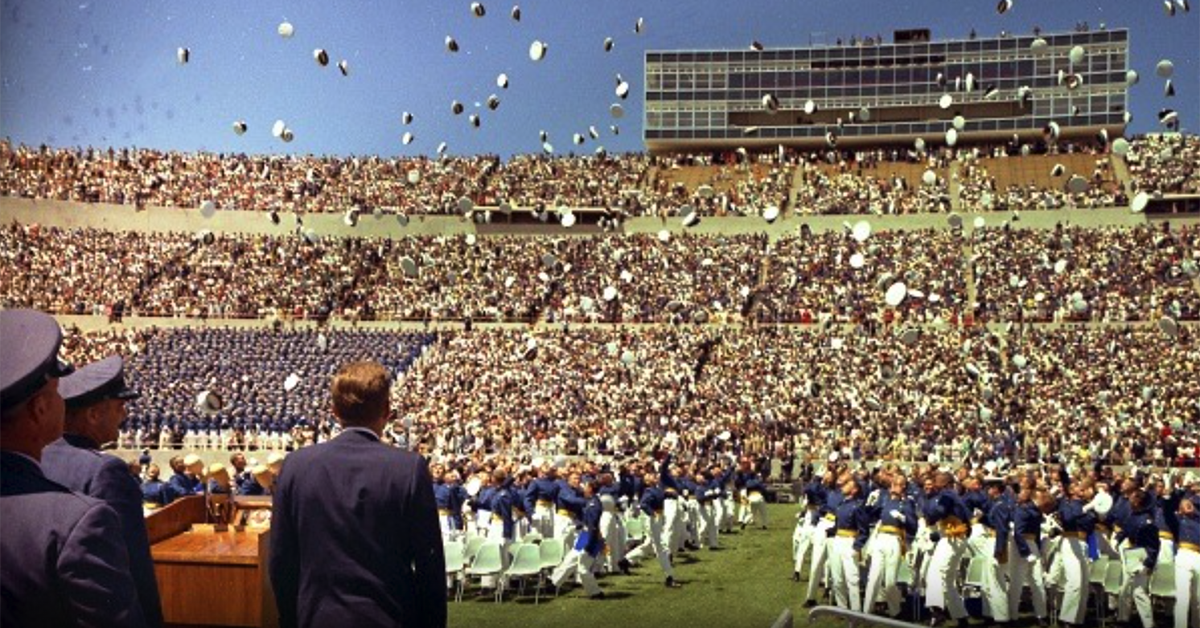
United States presidents make popular commencement speakers.
As leaders of the free world, they can’t possibly accept every invitation to speak before a graduating class. However, when a military academy offers that opportunity to a president, he tends to accept.
President John F. Kennedy was no different. He only resided in the White House for slightly less than three years, but he managed to speak at all three major U.S. military academies during his time in office.
Kennedy spoke at the U.S. Naval Academy in Annapolis, Maryland, in 1961. The next year, he delivered the commencement address at the U.S. Military Academy at West Point, New York. Then in 1963—less than six months before his assassination—Kennedy served as the commencement speaker at the U.S. Air Force Academy in Colorado Springs, Colorado.
JFK, who served in the Navy during World War II, didn’t regale the graduates with tales of his military service. He didn’t mention his heroic actions after the Japanese sank his patrol torpedo boat on August 2, 1943. Rather, Kennedy concentrated on the present and the challenges that lay ahead of them.
In all three speeches, Kennedy highlighted some common themes. Here are seven key points that JFK made to those future service members and military leaders and still resonate today.
Your Education Doesn’t End with a Diploma
During the early 1960s, Kennedy dealt with several hot-button issues, most of them related to the Cold War. Tensions with Russia escalated. One year after the embarrassing failure of the Bay of Pigs invasion in 1961, Kennedy confronted the Cuban Missile Crisis. Vietnam was a powder keg ready to explode.
Real-world events require that a service member learn from more than a textbook, Kennedy emphasized in his addresses. The dynamics within and between countries constantly shift, so the military must be adaptable and not overly rigid in its thinking.
“You cannot possibly have crowded into these four busy years all of the knowledge and all of the range of experience which you must bring [to your future assignments],” Kennedy said at West Point on June 6, 1962.
You Will Face an Awesome Responsibility
During JFK’s presidency, American universities and colleges conferred an average of approximately 400,000 bachelor’s degrees annually.
For those graduating from a military academy, that diploma comes with a promise to defend our nation. Then as now, those graduates became soldiers, sailors, or airmen—some of whom will be asked to risk their lives for principles and objectives they might not fully understand.
Kennedy assured the youthful, eager faces in front of him that the academies prepared them well. Although they were graduating during “the most difficult period in the life of our country,” they should be confident in their readiness.
“The demands that will be made upon you in the service of your country in the coming months and years will be really more pressing, and in many ways more burdensome,… than ever before in our history,” JFK said in Annapolis on June 7, 1961.
JFK referenced the nuclear age and space race during his speeches. America’s 35th president emphasized no one was sure where they would lead. Who knows? How many future astronauts, test pilots, or Pentagon leaders listened to Kennedy’s words on those days?
The same applies to the military academies’ classes of 2026. They have to deal with issues, such as artificial intelligence, that those in uniform in JFK’s day never did.
“Some of you will fly the fastest planes that have ever been built, reach the highest altitudes that man has ever gone to, and lift the heaviest payloads of any aviator in history,” Kennedy predicted at the Air Force Academy on June 5, 1963. “Some of you will hold in your hands the most awesome destructive power which any nation or any man has conceived.”
Don’t Pigeonhole Your Future
Depending on the direction of one’s career, a service member might not perform their service in a strictly military sense. As Kennedy pointed out, some graduates will negotiate with or advise foreign governments. Others will participate in cease-fire talks or serve important roles within the Defense Department. Some will hold down command posts.
They may become diplomats, politicians, or economic advisers. No matter what, they have a rare opportunity to effect change.
“You will be privileged in the years ahead to find yourselves so heavily involved in the great interests of this country,” Kennedy noted at West Point.
Force Is Not Always the Answer
The U.S. possessed arguably the world’s most technologically and strategically advanced military under JFK. America’s arsenal included its first submarine-launched ballistic missile, the LGM-30 Minuteman intercontinental ballistic missile, and the “Dragon Lady” reconnaissance aircraft.
Those weapons (and others like them) are there for a reason, Kennedy warned, but military leaders should never forget they should be used sparingly, if at all. Don’t make decisions without considering the potential consequences, the president said.
“You will need to understand the importance of military power and also the limits of military power,” Kennedy advised.
Don’t Expect a Constant Stream of Accolades
At West Point and Annapolis, Kennedy recited the same 19th-century saying on a sentry box at Gibraltar:
“God and Soldier, all men adore
“In time of trouble, and no more,
“For when the war is over, and all things righted
“God is neglected, and the old soldier slighted.”
Kennedy wanted the graduates in front of him to embrace the grind that so often is military life. A lot of their efforts won’t get public (or private) recognition. That doesn’t make their hard work any less important or impactful. Glory, which tends to come more easily during armed conflicts, isn’t the be-all, end-all of military service.
JFK wanted them to focus on why they committed to serve their country in the first place.
“There is no single slogan that you can repeat to yourself in hard days or give to those who may be associated with you,” Kennedy said. “In times past, a simple phrase—‘54° 40′ or fight’ or ‘to make the world safe for democracy’—that was enough. But the times, the weapons, the issues are now more complicated than ever.”
The US Is Grateful to You
Even if other Americans don’t express it, they know their defense and freedom rest with a strong military. Surviving four years of a military curriculum and training placed those graduates on a path to do potentially great things. JFK had no doubt they would despite the heavy weights on their shoulders.
“This is a burden which we accept willingly, recognizing that if this country does not accept it, no people will, recognizing that in the most difficult time in the whole life of freedom, the United States is called upon to play its greatest role,” Kennedy said.
Don’t Miss the Best of We Are The Mighty
• The sensational defection of Stalin’s daughter to the US during the Cold War • The Cuban Missile Crisis: 13 days that almost ended the world • How this Air Force spy plane traveled from coast to coast in record time
JFK’s words of wisdom to the military leaders of tomorrow
The tradition and history of the military Challenge Coin
5 easy ways to support veteran-owned local businesses
These were the last surviving veterans of every major American war through World War I
World War II
An Army vet honored a fallen comrade with a historic Appalachian Trail hike
Related Service stories

Yes, I Served in Iraq. But What if People Mistake Me for a Hero?
Illustration by Kim Vo The Department of Motor Vehicles was a good place to lose your identity, not find it, especially 30 minutes before cl
Officers only: New report lays out what a ‘US Cyber Force’ could look like
A new report argues that an independent Cyber Force should be staffed by only commissioned officers and warrant officers to better develop t
Navy researchers find wreck of World War II submarine that vanished 82 years ago
Nearly 82 years to the day after the USS Herring went missing during World War II, the Navy said it had found the wreck of a submarine that