From 7.62 to 5.56 to the new 6.8mm—did the Army finally get its round right?
Every motor pool, every smoke pit, every chow-hall table has hosted the same argument at least once. Somebody swears the 5.56mm is a glorified BB gun that couldn’t stop a determined house mouse. Somebody else, usually an old senior NCO with a severe flat top, long-gone gray, insists that nothing ever beats the 7.62mm and that the Army has been wrong since Vietnam. Then some E-4 brings up the new 6.8mm, and the whole table groans into its coffee.
Here’s the thing about that argument (something that’s true about most arguments): everyone at the table is a little bit right. And the Army just reopened the whole banal, yet beautiful brawl by spending more than $7 billion to slap a brand-new round into the next service rifle.
So let’s settle this with a tale of the tape: three cartridges, one squad, and no need to agree with the highest-ranking person in the group.
7.62mm: Big Iron
Back in 1957, the Army adopted the M14, a gorgeous slab of walnut and steel that fired the 7.62mm NATO round and replaced the M1 Garand. The thing hit like a “Dear John” letter. It also fought you the entire time you held it.
Crank it to full automatic, and the recoil walked the barrel toward low-earth orbit, so your first shot was a love letter; the rest, however, were a strongly-worded suggestion.
The M14 was dense, too. It was heavy, the ammo was heavier, and a grunt can only hump so much of either before his lower back files for divorce and his knees want a separation. The brass did the math and blinked. Defense Secretary Robert McNamara, ever the mathematician, pulled the plug on M14 production on Jan. 23, 1963. The old bruiser had power to spare and nowhere good to put it.
5.56mm: Conceived By a Stoner
Designer Eugene Stoner took his 7.62mm AR-10 and shrunk it into a lighter rifle firing a fast little .22-class bullet. That rifle became the M16, and its round became the 5.56: Light enough that you could carry a small mountain of it, yet soft enough on recoil that you could actually hold a burst on target. And the Army of the 1960s had fallen hard for volume of fire, the gospel that more bullets downrange beats fewer fat ones.
The M16 went to Vietnam in 1965, the improved M16A1 became the standard service rifle by 1969, and the skinny kid eventually grew into the M4 carbine that rode shotgun through the entire Global War on Terror. Critics swore the little round lacked real stopping power, and this chorus crescendoed once the enemy started showing up in body armor.
6.8mm: The New Kid
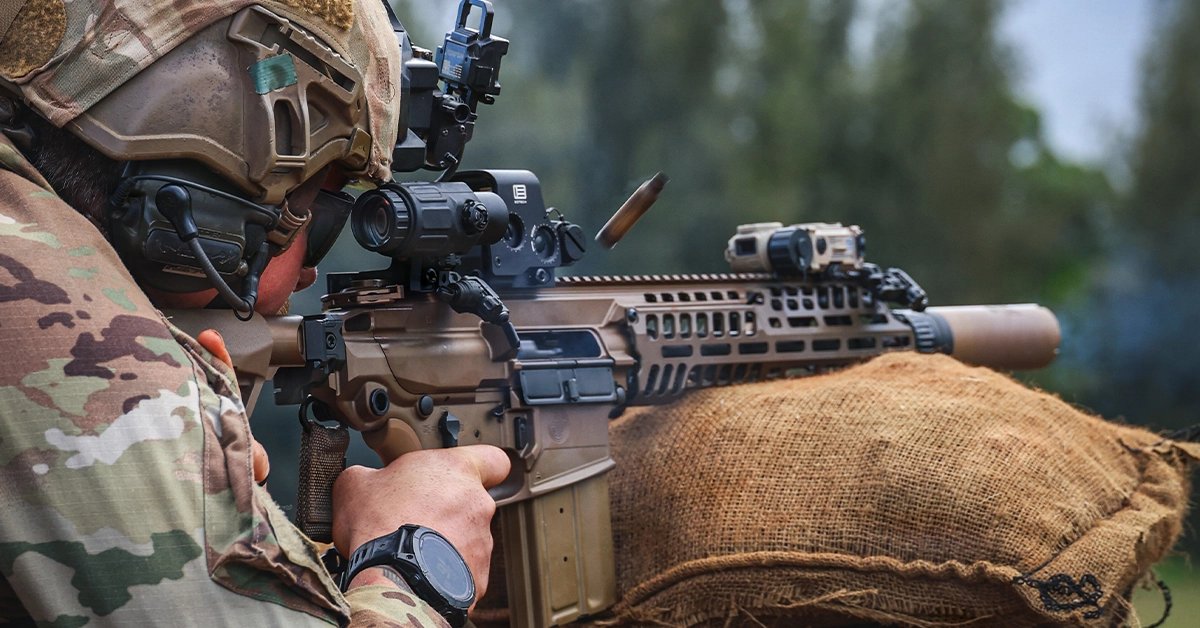
Worried that improving armor would shrug off the 5.56 at distance, Army leadership launched the Next Generation Squad Weapon program in 2019, and SIG Sauer won the contract on April 19, 2022. The prize package is two weapons, the M7 rifle and the M250 automatic rifle, both firing a beefy new 6.8mm round called the .277 Fury, wearing the M157 smart optic that does your ballistic homework for you.
A high-level understanding of physics and ballistics was needed to persuade the unsure to proceed with procurement.
“It stops the enemy at one round versus having to shoot multiple rounds at the enemy to get them to stop,” as Brig. Gen. Phil Kinniery laid it out with great tact and sophistication.
Now, the smart part, because the knees of every old grunt are already yelling that a fatter round means a lighter combat load.
The new 6.8mm use a hybrid case, a brass body welded to a steel head, that handles monster pressure while shaving more than 20% off the weight of an all-brass cartridge. In other words, the Army is not crawling back to the 7.62. It built a middle child that wants the old man’s punching power and the skinny kid’s carrying weight at the same time.
What’s the Beef?
In April 2025, at the Modern Day Marine expo, Army Capt. Braden Trent stood up and called the rifle “unfit for use as a modern service rifle,” knocking its weight, its recoil, a stingy 20-round magazine, and reliability problems he said showed up under hard use.
The Army and SIG Sauer fired right back, defending the weapon and waving off his conclusions. And the Marines? The Corps took one long look at the M7 and said no thanks, deciding in February 2026 to keep its 5.56mm M27 instead.
Its logic is hard to argue with; the M27 simply fits how Marines fight, and 5.56 is NATO-standard, so a Marine running low can bum a magazine off any nearby ally and know they’ll have plenty of usable ammo all around them. The Army’s 6.8mm rides its own private supply chain, and good luck mooching that.
Is There a Winner?
If there is a silly secret to this whole tale of the tape, it’s that nobody wins. 7.62mm was too much gun for too few rounds. 5.56mm was the perfect lightweight right up until the enemy bought armor. The 6.8mm is certainly a bold choice, and it is hauling a heavier round, as well as a fresh logistics headache.
Our Army is betting billions that heavier and smarter weapons will win the battle. The Marines are betting on lighter and plentiful, still winning when it counts the most. The old 7.62 crowd is in the back, nodding off in between gloating and waiting for the colonoscopy results.
But the only judge who has ever scored this fight straight does not sit at a chow-hall table or a Pentagon desk. Those who get shot at then have to shoot back, they get a vote, and theirs should be the vote that carries the most weight.
Don’t Miss the Best of We Are The Mighty
• Your standard rifle can now be an anti-drone weapon. Seriously. • The infantry hates the XM7 rifle (and why the Army doesn’t care) • Why the Army doesn’t need the Sig Sauer M7 rifle
From 7.62 to 5.56 to the new 6.8mm—did the Army finally get its round right?
Why miniguns like the M134 can fire thousands of rounds per minute and not jam
The Navy ordered $23.4M of hypersonic missiles to be launched from drones
Ruger moved from Connecticut to North Carolina and didn’t tell anyone
The Marines and the rare rifles you didn’t know were at D-Day
Related Service stories

Yes, I Served in Iraq. But What if People Mistake Me for a Hero?
Illustration by Kim Vo The Department of Motor Vehicles was a good place to lose your identity, not find it, especially 30 minutes before cl
Officers only: New report lays out what a ‘US Cyber Force’ could look like
A new report argues that an independent Cyber Force should be staffed by only commissioned officers and warrant officers to better develop t
Navy researchers find wreck of World War II submarine that vanished 82 years ago
Nearly 82 years to the day after the USS Herring went missing during World War II, the Navy said it had found the wreck of a submarine that