The Army bought 10,000 IVAS headsets. Soldiers won’t use them.
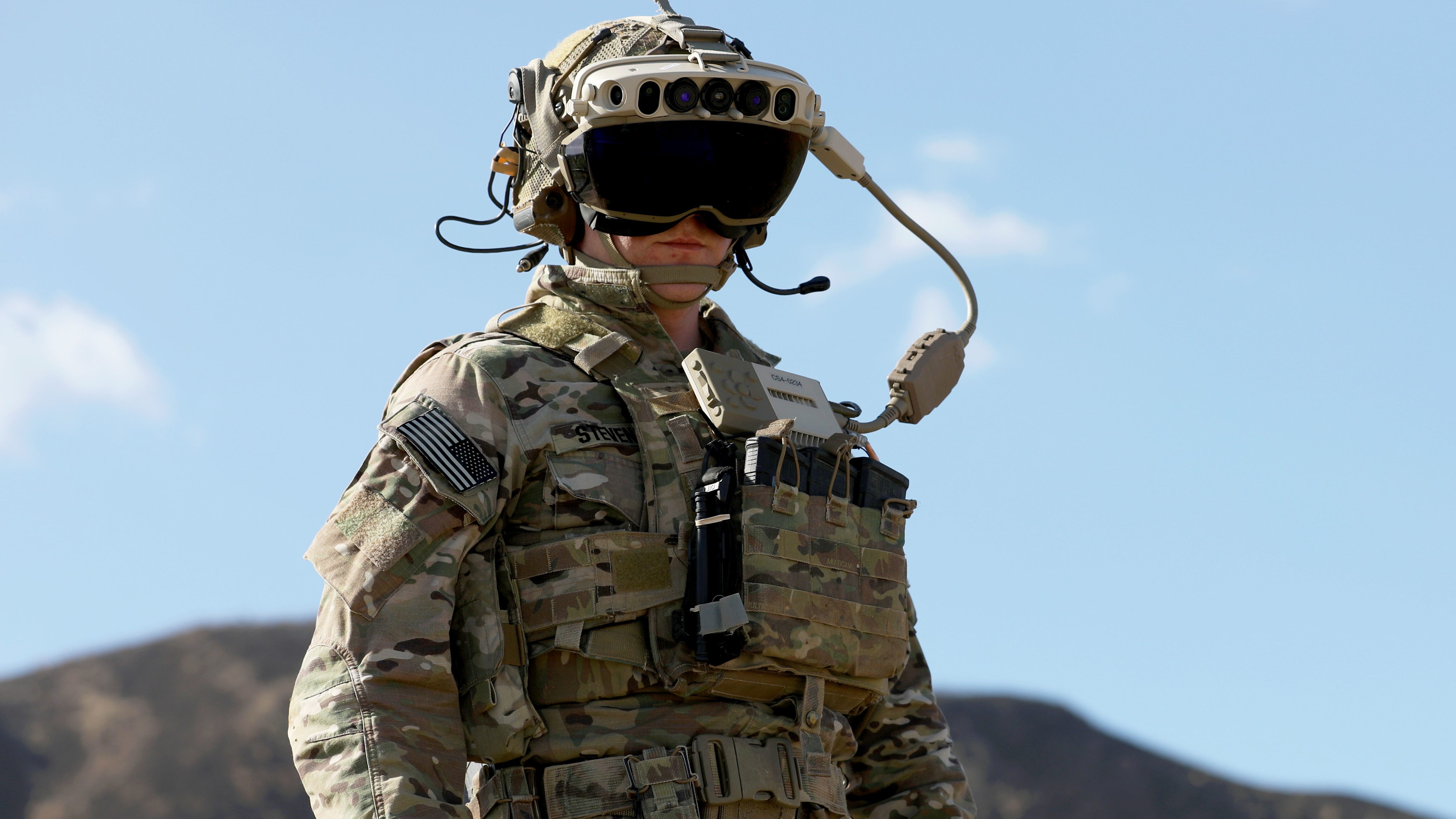
The Army spent over a billion dollars on nearly 10,000 augmented-reality headsets for soldiers to wear in combat. A federal watchdog reported this week that they won’t end up being used.
The Government Accountability Office looked at programs across the Department of Defense that “exceeded cost estimates and delivery schedules — wasting billions of dollars and decades of time,” according to a report released Tuesday. One of the programs highlighted in the report is the Army’s Integrated Visual Augmentation System, or IVAS headset program.
The service has produced nearly 10,000 units of the first two versions of IVAS headsets, which “have fallen short of soldiers’ needs and will go into storage, with some potentially used for testing, rather than to the field,” GAO said in its report.
Army officials, after this article published, said that the Army decided not to field the first 10,000 IVAS systems following soldiers’ feedback, and that the operational reliability was “not acceptable.” However that decision was not made until after the procurement was done.
“The Army developed and received over 400 IVAS 1.2 prototypes that improved the low light sensor performance and reliability sufficiently with minor improvements to the form factor, but they were unaffordable to produce at scale,” Army spokesperson Ellen Lovett said in a statement to Task & Purpose. “The Army decided to pivot to the Soldier Borne Mission Command System underpinned by a ‘Company and Below’ architecture informed by lessons learned from the IVAS program.”
The IVAS 1.2 prototypes are being used as SMBC surrogates, Lovett said, and have been used in the ongoing mission at the U.S.-Mexico border.
In 2024, the Army released photos of soldiers using IVAS sets in training exercises at Fort Drum, New York. In August 2025, soldiers told Task & Purpose that they were using IVAS headsets during patrols at the U.S.-Mexico border in coordination with border patrol agents.
The goal of IVAS was to give soldiers a digital headset that improves their situational awareness while in combat with a mixed reality heads-up display that projects images onto a digital screen which is attached to a soldier’s helmet.
GAO said IVAS, which launched in 2018, “has yet to deliver operational capability” after multiple iterations of headsets.
Headaches, neck strains, and a billion dollars
In November 2018, the Army awarded a 10-year, $22 billion contract to Microsoft to begin building and delivering prototypes of the headsets. In 2021, Army officials announced that IVAS testing and fielding would be delayed for another year. By 2022, the Pentagon’s testing office began running early versions of IVAS through training scenarios and found that soldiers hit fewer targets and engaged them more slowly with IVAS 1.0 than with their current equipment. Soldiers wearing the headsets for the demos reported feeling disoriented or suffering eye and neck strains, headaches, and motion sickness.
Another report from 2022, this time in an audit by the Department of Defense’s inspector general, found that the program still had undefined “minimum user acceptance levels to determine whether IVAS would meet user needs.” The IG warned that it could mean wasting nearly $22 billion in taxpayer funds “to field a system that soldiers may not want to use or use as intended.”
More insight into the program’s demise also came this week from a Defense Department watchdog’s comments at a House hearing Tuesday. Carmen Malone, an assistant inspector general who audits DoD acquisition programs, said the Army’s fast-moving requirements for IVAS led the program to adopt “immature technologies,” which led to redesigns, delays and higher costs.
“When requirements are unstable or overly ambitious, programs pursue systems they are not ready to build,” Malone said.
The report estimated that the Defense Department actually spent about $1.8 billion on the IVAS system, a number GAO officials confirmed to Task & Purpose matches their own estimate of the total dollars spent on the program before it was canceled.
GAO noted that despite the shortcomings of the IVAS program, the service has instead moved to “a new rapid prototyping program” called the Soldier Borne Mission Command, or SBMC. In September 2025, Anduril announced that it was selected to develop a prototype for the new SBMC program.
While Anduril has not yet produced an SBMC prototype, the company has been showing off its self-produced EagleEye headset at military conferences. EagleEye, officials told Task & Purpose, was designed to improve on the critiques of IVAS, like the neck pain that soldiers complained about. To address that, EagleEye puts the headset’s battery into a ballistic chest plate to take the weight off soldiers’ heads.
The latest GAO report was done as part of the watchdog’s ongoing assessment of how the Department of Defense moves too slowly compared to how fast emerging technology evolves.
“The expected time frame for major programs to deliver an initial capability now exceeds 12 years,” GAO wrote.
Update: 6/12/2026; This article has been updated with a statement from the Army.
Related Service stories

Yes, I Served in Iraq. But What if People Mistake Me for a Hero?
Illustration by Kim Vo The Department of Motor Vehicles was a good place to lose your identity, not find it, especially 30 minutes before cl
Officers only: New report lays out what a ‘US Cyber Force’ could look like
A new report argues that an independent Cyber Force should be staffed by only commissioned officers and warrant officers to better develop t

Navy researchers find wreck of World War II submarine that vanished 82 years ago
Nearly 82 years to the day after the USS Herring went missing during World War II, the Navy said it had found the wreck of a submarine that