The biggest challenge Charles Lindbergh faced in flying across the Atlantic
Growing up on a farm in Minnesota, Charles Lindbergh often lay in the grass and looked up at the clouds.
The young boy wanted to be closer to them, and the only way he knew how was to learn to fly. His father was against the idea, but Lindbergh was determined. From his first time at the controls of an airplane in 1922, he was transfixed.
“My early flying seemed an experience beyond mortality,” Lindbergh recalled. “There was the earth spreading out below me, a planet where I had lived but from which I had astonishingly risen.”
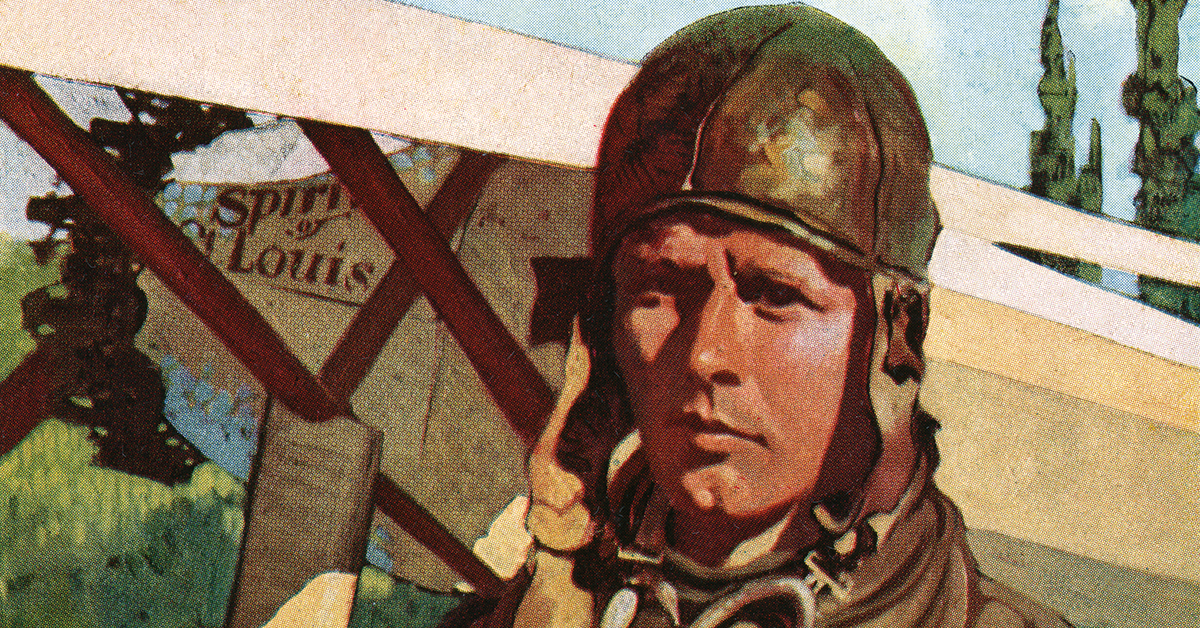
Five years later, the entire world was astonished as Lindbergh became the first person to complete a solo, nonstop transatlantic flight. Setting out from Long Island, New York, on May 20, 1927, Lindbergh piloted the Spirit of St. Louis for 33½ hours.
An ebullient crowd of 150,000 people greeted Lindbergh after he landed in Paris shortly before 10:30 p.m. on May 21. Lindbergh deserved every bit of that adulation.
The Race to Collect a $25,000 Prize
Born in France but living in New York, Raymond Orteig was a hotelier and philanthropist in the 1920s.
Orteig also loved aviation. That passion sparked him to offer $25,000 to anyone completing a flight from New York to Paris (or vice versa). Orteig’s prize inspired no shortage of aviators, but Lindbergh seemed an unlikely pick to collect it.
In 1927, Lindbergh was only 25 years old, had never attempted anything of this magnitude, and didn’t have the financial wherewithal to support such an endeavor. Befitting the former barnstorming stunt pilot that he was, Lindbergh had plenty of moxie, enough to raise the requisite funds to build a single-engine monoplane.
Lindbergh, who flew for the Army Air Service in 1924 and 1925, was determined to fly to Paris alone.
“I’d rather have extra gasoline than an extra man,” he asserted to his chief engineer.
A Weary Lindbergh Begins Hallucinating
Lindbergh was so excited about getting started that he barely slept in the day before the Spirit of St. Louis took off from New York.
Fatigue was his biggest challenge, a relatively frequent, though unwelcome, companion. Lindbergh tried to combat its onset as best he could, even buzzing the ocean at times to feel the refreshing spray of water.
The spray’s effect was short-lived, however, and Lindbergh reported falling asleep for brief intervals, sometimes with his eyes open, while flying through fog. The ambitious pilot briefly closed the plane’s windows, thinking the warmth might reinvigorate him, before determining he could not do without feeling the brisk, cold air.
Lindbergh’s exhaustion became so pronounced that he began experiencing hallucinations roughly two-thirds of the way into the 3,610-mile flight. Lindbergh recounted seeing “fog islands” in the Atlantic and “vaguely outlined forms, transparent, moving, riding weightless with me in the plane.”
Lindbergh desperately needed a pick-me-up. He received it when he realized he was flying over Europe.
Flying over Europe
It was about 3 p.m. local time when Lindbergh saw a stretch of land, consulted his navigation charts, and determined he was approaching southern Ireland.
“This is earth again, the earth where I’ve lived and now will live once more,” Lindbergh wrote of that moment in his Pulitzer Prize-winning autobiography, “The Spirit of St. Louis.” “Here are human beings… I’ve been to eternity and back. I know how the dead would feel to live again.”
Not only that, but the Spirit of St. Louis was 2½ hours ahead of schedule, according to a timeline of Lindbergh’s flight. In the homestretch of making history, Lindbergh increased the plane’s speed to 110 mph. That allowed him to achieve a goal of crossing the French coastline before sunset.
The Spirit of St. Louis touched down in Paris at 10:22 p.m. It had been a grueling 55 hours since Lindbergh slept, but in that moment, the aviator was likely too excited to sleep.
“Lucky Lindy” Promotes Aviation
After touching down, Lindbergh instantly became arguably the world’s most famous man. The former farm boy who previously had parachuted to safety four times as a pilot (earning himself the nickname “Lucky Lindy”) had done the inconceivable.
Such an accomplishment deserved rest. Lindbergh, though, didn’t get much of it in the months ahead. Two months after touching down in Paris, Lindbergh embarked on a three-month tour of the United States. Following that, Lindbergh traveled to 15 countries in Latin America, an assignment during which he met his wife of 45 years, Anne Morrow.
Along the way, Lindbergh espoused the merits of aviation. He was the perfect spokesperson after seeing firsthand why it was so important to push boundaries.
“What kind of man would live where there is no danger?” Lindbergh said after his history-making flight. “I don’t believe in taking foolish chances, but nothing can be accomplished by not taking a chance at all.”
In recognition of Lindbergh’s transatlantic flight, President Calvin Coolidge presented the aviator with the Medal of Honor on March 21, 1928, at the White House.
Lindbergh died on August 26, 1974, at the age of 72.
Don’t Miss the Best of We Are The Mighty
• A guide to military aviation and warfare • The combat jumps of the 187th Airborne Regimental Combat Team in Korea • The WWII bombardier whose family spent 12 years bringing him home from the ocean floor
Medal of Honor
The biggest challenge Charles Lindbergh faced in flying across the Atlantic
This one fix could make the M4 a near-perfect carbine
That time Neil Armstrong survived ejecting from his fighter jet in Korea
World War II
A Medal of Honor recipient used a dud enemy mortar to save US troops during WWII
How the Civil War created the modern American funeral industry
By Daniel Tobias Flint