The fascinating history of the military duffel bags we know and love
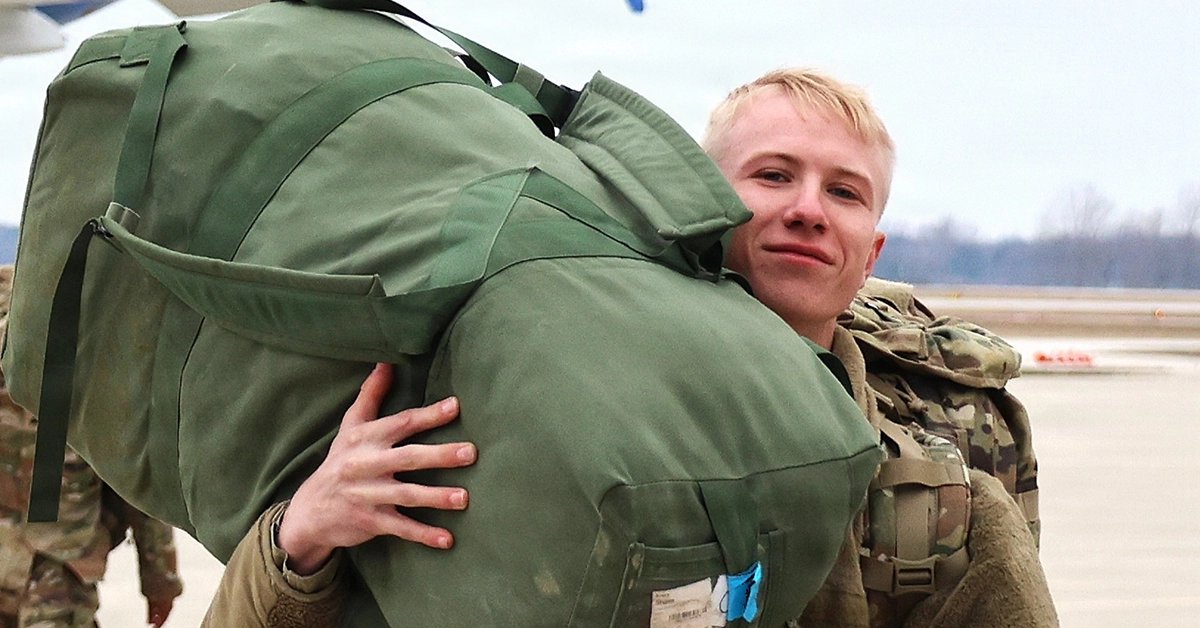
You can spot it from across any airport, slung over one shoulder, listing the person carrying it about fifteen degrees off vertical. The military duffel is not elegant. It is a fabric tube with a strap, a cylinder of canvas or nylon that holds everything a service member owns and surrenders none of it without a fight.
Whatever you need is at the bottom. It is always at the bottom. That is how the fundamental physics of the thing—a law as old as the bag itself—works.
The duffel will never get a statue, a callsign, or a slow-motion hero shot. It is the least glamorous object the military ever handed you, and also the most loyal, the one piece of gear that followed you from the first day of boot camp to your last move, dragged across every parking lot, gym floor, and tarmac in between.
The Navy calls it a seabag. Everybody else calls it a duffel. Either way, it has been quietly hauling the entire contents of a military life for more than two centuries, and it has barely changed, because it barely needed to.
Bury the Box, Grab the Bag
It started, in true naval tradition, with an officer who could not stand clutter. In 1803, aboard the USS Constitution, Commodore Edward Preble, a man remembered as a stickler for neatness, ordered that bags be issued to his crew in place of their wooden sea chests.
Knockoff pirate treasure chests ate up precious room on a crowded warship, so the common sailors lost theirs. The petty officers, naturally, were allowed to keep theirs, because some things will never change. Within a decade, the chest had all but vanished from the fleet, replaced by a soft sack a man could cram into any corner.
Those first bags were flax linen, painted black to keep the seawater out, and closed with a drawstring at the top, which means the modern misery of the top-loader is not modern at all. Herman Melville griped about it in the 1840s, complaining that a sailor could get into his black bag only once a day, and only during a stretch of utter chaos.
Two centuries before you stood in a barracks dumping an entire bag onto a bunk to find one clean sock, a future literary giant was doing the same thing and hating it exactly as much as you did.
Sailors made the bags their own from the very beginning. They painted their names on the canvas, and some went further.
A gunner on the Constitution named John Lord decorated his with a cannon and a fouled anchor stacked over a pile of cannonballs, which is simply the 1820s version of the guy who covers his duffel in unit patches and the names of every base he ever passed through.
The military bag evolved the way the military evolves everything, slowly, expensively, and while quietly complaining. Original models were almost 4 feet tall when filled and were black. By the early 1900s, it had turned white and shrunk to a more manageable thirty-six inches.
Sailors learned to split their gear between the bag and their hammock so they could actually find things, a workaround that earned its own name, the lash-up, and hardened into a tradition that outlived the problem it solved.
For generations, the bag carried your bedroom like a mule, first your hammock and later your mattress. That happily ended after World War II, when the Navy stopped issuing hammocks, and a new regulation finally spared sailors from dragging a dirty personal mattress around the globe.
Your redesigned bag picked up the features it still, umm, features today, such as a shoulder strap, an outside pocket, and a locking closure, and it got a great deal lighter to love.
The version most people picture arrived in two steps. In 1952, the services settled on a single olive-drab bag, and that quiet act created the naming schism that survives to this very day, a seabag to the Navy and a duffel to everyone else, one tube to rule them all.
Vietnam ushered in nylon and proper straps, so a person could finally wear it across the back like a pack instead of lugging it like a sack of emotional baggage.
It’s a Keeper
You and your duffel become a relationship, and not a healthy one either. It will try to dislocate one shoulder, then offer to even things out by snapping a rotator cuff in the other. It develops a signature funk over the years as well, a blend of molding canvas, foot powder, and stains sweated through, that no amount of washing ever fully removes.
It demands you move it like a graceless bride, half-carrying, half-shoving it across the floor for the moments when the thing is simply too heavy to lift with any real dignity.
And yet you loved it. You wrote your name on it. You added the patches, the unit, the places you had been, exactly like a gunner did with a paintbrush two hundred years ago.
A faded, beaten, salty old duffel is a badge of honor, proof that you went somewhere hard and came back, provided it still seals and the seams still hold.
People will keep them long after the uniform comes off, hauling them down from a closet shelf to move a kid into a dorm or to haul camping gear, still full of funk, but still loyal, still impossible to pack correctly.
That is the strange allure of the dumbest bag in the military. It asks for nothing, complains never, and quietly carries everything you own through the hardest years of your life.
It outlasted the sea chest, the hammock, the mattress, and a dozen wars, and it will almost certainly outlast the rest of us, too, waiting on a closet floor somewhere with one clean sock still wedged at the very bottom.
Don’t Miss the Best of We Are The Mighty
• Why the US military wants to take your wisdom teeth so fast • A 100-plus year history of iconic US military helmets • The US military’s drinking water was the worst water you’ve ever loved
The fascinating history of the military duffel bags we know and love
The tradition and history of the military Challenge Coin
From 7.62 to 5.56 to the new 6.8mm—did the Army finally get its round right?
Why the US military wants to take your wisdom teeth so fast
From Decoration Day to Memorial Day: How the US came to honor its fallen heroes
Related Legacy stories
This American flag survived D-Day, then was returned to the US 75 years later
When Howard Vander Beek died in 2014 at the age of 97, he left behind a distinct reminder of his World War II service. Vander Beek, a lieute
Medal of Honor recipient and legendary Vietnam War helicopter pilot ‘Old Snake’ has died
Retired Army Col. Bruce Perry Crandall, the legendary helicopter pilot who was awarded the U.S. military’s highest decoration for valor for
Air Force crew honors WWII-era Flying Tigers with A-10 paint job
It started as a routine transfer. Following an asset transfer from Korea, maintainers at Moody Air Force Base, Georgia, accepted and process