The last Marine Corps AAV had its final field exercise
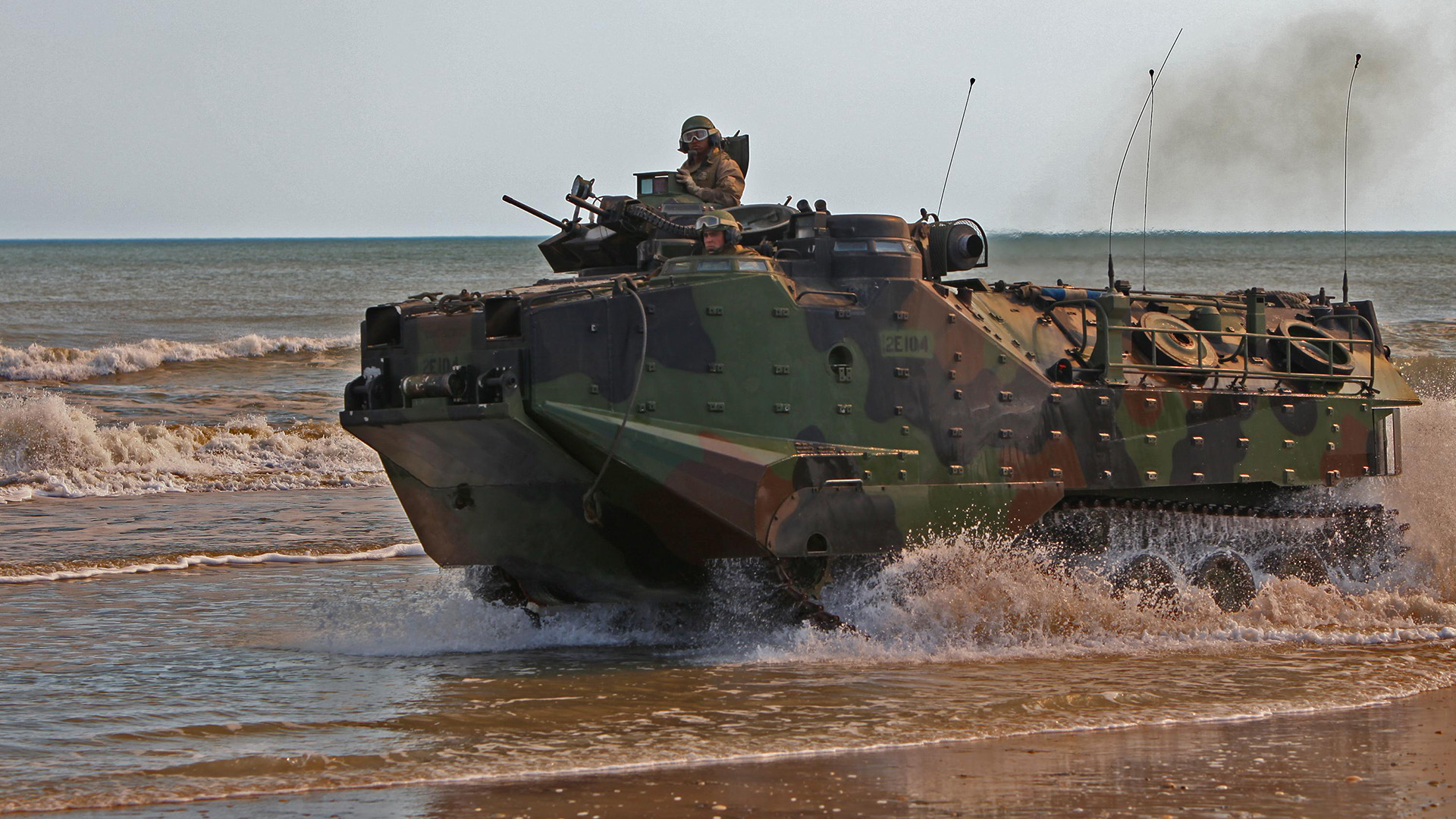
The Marine Corps’ last serving amphibious assault vehicles, beastly machines affectionately known to Marines as “tracks,” recently completed a final field exercise ahead of their planned retirement, Corps officials said this week.
The 4th Assault Amphibian Battalion, the last Marine unit still operating the officially retired vehicles, took part in Exercise Sea Breeze 26 last month in Romania. The event marked the final Marine Corps operations with the vehicle, which is often referred to by its acronym, AAV, a Marine Corps news release says.
The battalion’s AAV’s will next be permanently retired and transferred to foreign partners,said Capt. Steven J. Keenan, a Marine Corps spokesman.
Lt. Col. Nishan Campbell, commander of the 4th Assault Amphibian Battalion, said he has spent his entire Marine Corps career as an “Amtracker,” serving in amphibious assault vehicle billets. He said life among AAVs required a mindset fundamental in Marine culture: ‘embracing the suck.’
Top Stories This Week
Air Force cancels promotions for 135 sergeants after testing error
Army rolls out rules on waist-to-height body standards
Navy offers up to $280,000 in bonuses to keep reserve aviators
By Nicholas Slayton, Jeff Schogol
“It really sucks when you’re doing it,” Campbell said in the Marine Corps news release. “But it’s the best when you come back and think about how much it sucked. You’re all in the suck together.”
After Romania, the Marines will no longer use the vehicles for deployments, operations, exercises, or training events, said Keenan, who added that the Corps has now transitioned to the eight-wheeled amphibious combat vehicle.
“Marines may continue to train partner forces in their employment of the AAV but will not employ the AAV within Marine Corps formations,” Keenan told Task & Purpose.
Last year, the Marine Corps formally retired its amphibious assault vehicles in active-duty units. The 4th Assault Amphibian Battalion has continued to use a small number of AAVs for land-based training and bilateral exercises overseas that had been preplanned.
Weighing between 25 and 30 tons,the tracked vehicle first entered service with the Marine Corps in 1972. Designed to ferry Marines from ship to shore, the vehicle was also used as part of ground operations, such as the 2003 invasion of Iraq. Two years later, 14 Marines and a civilian interpreter were killed in August 2005 when one of the vehicles was destroyed by a roadside bomb in Haditha, Iraq.
During its more than 50-year career with the Corps, the vehicle has seen service in Lebanon, Grenada, Indonesia, and in Mississippi and Louisiana following Hurricane Katrina.
Concerns about the vehicles’ age and condition arose after eight Marines and one sailor died in July 2020 when one of the vehicles sank off San Clemente Island, California.The mishap was the deadliest training accident involving an amphibious assault vehicle in Marine Corps history. A subsequent investigation found that most of the Marine Corps’ vehicles failed an inspection following the accident.
The following year, the Marine Corps announced that the vehicles would no longer be part of deployments or used for waterborne training. Those restrictions remain in place, said Keenan.
Related Service stories

Yes, I Served in Iraq. But What if People Mistake Me for a Hero?
Illustration by Kim Vo The Department of Motor Vehicles was a good place to lose your identity, not find it, especially 30 minutes before cl
Officers only: New report lays out what a ‘US Cyber Force’ could look like
A new report argues that an independent Cyber Force should be staffed by only commissioned officers and warrant officers to better develop t
Navy researchers find wreck of World War II submarine that vanished 82 years ago
Nearly 82 years to the day after the USS Herring went missing during World War II, the Navy said it had found the wreck of a submarine that