Chinese farmers built a road up an impassible mountain to bring home American airmen from World War II
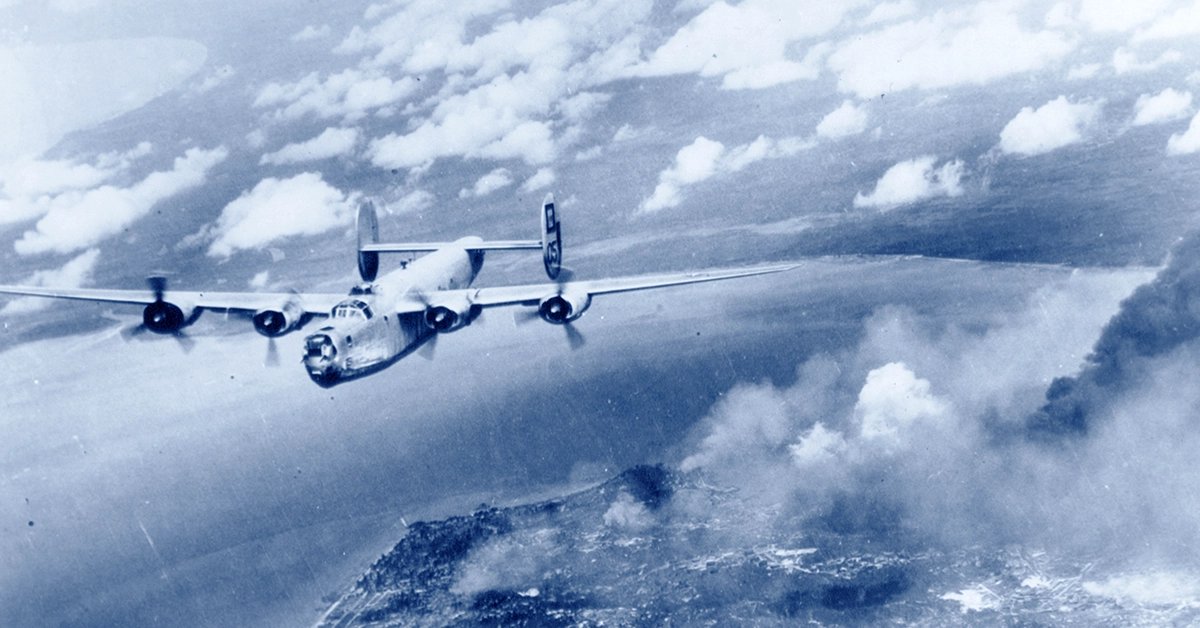
“God help us if we go down here,” William Drager, a 25-year-old tail gunner from Hackettstown, N.J., wrote to his family in the late summer of 1944. “They’ll never find us because this is the most rugged country I’ve ever seen.”
He was right. For 52 years, anyway.
The 10-man aboard his B-24 Liberator bomber would get lost following an attack on Japanese positions. They didn’t just lose their way; they were lost to the world until 1996, when they were found by two Chinese farmers. What the local people did to bring them home was extraordinary, proof that some debts can never fully be repaid.
On Aug. 31, 1944, Drager and nine fellow airmen climbed into a B-24 Liberator named “Tough Titti” to fly their first combat mission. They were part of Gen. Claire Chennault’s legendary 14th Air Force, operating out six airfields in southern China under one of the most demanding (and bold) commands of World War II.
Their target that night was Takao Harbor off the coast of Taiwan, then known as Formosa and firmly under Japanese occupation. Their job was to drop 500-pound acoustic mines and get out clean.
They didn’t get out clean. Drager’s letter was the last he ever sent home.
As the 11-plane squadron bored in on Takao Harbor in the dark, the Japanese lit up the sky with radar-guided searchlights. Antiaircraft guns split open the silent night. Lt. James Miracle, flying in another aircraft just close enough to see what was happening, later called it the “roughest mission in the theater.”
He watched his friend Lt. George Pierpont’s plane take fire, and on the way back, made a terse entry in his diary: “George Pierpont’s crew first mission, lost.”
Pierpont’s crew was, in fact, lost.
Damaged, disoriented, and flying through the fog-choked mountain ranges of Guangxi province, Pierpont tried to bring his plane down. His home base at Liuzhou was under Japanese counterattack, so that was out.
He turned for Guilin, but the weather closed in. Somewhere in the darkness above what locals call Mao’er (“Little Cat”) Mountain, the plane ran out of options. It hit the granite face of the highest peak in southern China at 7,068 feet and came apart on the slope. All ten men were killed.
The wreckage stayed exactly where it landed, undisturbed on a near-vertical cliff face, buried under bamboo and fog, for more than half a century. William Drager’s letter was a prophecy.
The war moved on without them. Chennault’s 14th Air Force kept hammering Japanese supply lines and shipping across China and the South China Sea. The Allies island-hopped their way toward Japan until Japan’s surrender.
World War II ended, the Cold War began, and the Cold War ended. The whole sweep of the late 20th century happened while ten young men lay forgotten on a misty mountain in Guangxi.
About 1,000 U.S. aircraft went down over China during World War II, and roughly 100 of them were still unaccounted for by the mid-1990s. Today, according to the National WWII Museum, nearly 72,000 American service members remain unaccounted for from that war alone.
The Defense POW/MIA Accounting Agency has been working through that list for decades, one crash site at a time. But some of those sites, buried in the mountains of China, stayed out of reach for a long time. It wasn’t from a lack of effort, but rather a combination of geography, politics, and sheer remoteness.
Then, on Oct. 2, 1996, two farmers named Jiang Jing and Pan Qibing went hunting for wild herbs on Mao’er Mountain. They found a bomber instead.
The two men scrambled over the slope and took in what 52 years of weather and vegetation left of the B-24 Liberator: twisted aluminum, scattered debris, and the remains of 10 lives cut short. They reported what they found to local officials, who passed it up the chain, and it kept being reported until it reached the desk of Chinese President Jiang Zemin.
A month later, at the APEC summit in Manila, Jiang told President Bill Clinton about the discovery and promised full cooperation in recovering the remains. That December, China’s Defense Minister personally handed U.S. officials the dog tags recovered from the site—the first hard confirmation of who was on that plane
Back in Fort Lauderdale, Jim Drager got a phone call that changed everything. He was 52 years old, but was only three months old when his father flew off into the night in China and never came back.
His entire life, the family assumed the worst, that the plane had gone down over the Taiwan Strait, into shark-infested water. Now they knew otherwise.
“My father was just a citizen-soldier doing his job,” he told the Los Angeles Times. “It is just awesome that they found them after all these years. We thought they had been lost at sea.”
The problem, then, was reaching their remains.
One does not simply walk up into the Mao’er Mountains. The crash site sat on a near-vertical granite face, wrapped in bamboo, slick with the region’s near-constant mist. There was no road. There was no trail. There was nothing.
So the people of Xing’an County built one.
Some 500 local residents organized themselves and spent two months cutting a path and digging a road through the rugged terrain toward the crash site. They weren’t engineers, soldiers, or government contractors. They were farmers and villagers who grew up in the shadow of the mountain, and they understood that those 10 men deserved to come home.
They picked up shovels and got to work.
By January 1997, U.S. military forensic specialists from the POW/MIA Office in Washington were able to make the trek in. Even with the new road, the final approach to the site required descending on ropes and vines, grasping bamboo saplings on a slope that was ready to kill anyone who lost their footing.
A test dig turned up partial human remains almost immediately. Three black boxes of recovered material were formally handed over by Chinese Foreign Ministry official Mei Ping to U.S. Ambassador James Sasser, who passed them to members of an honor guard.
On Jan. 17, 1997, flag-draped metal caskets were carried onto a C-141 Starlifter military transport and flown to a laboratory in Hawaii for identification. The youngest of the ten men had been 19 when he died. The oldest was 27. One of them died on his 24th birthday.
Liang Ziwei, the director of foreign affairs for Xing’an County, told the assembled reporters what the moment meant to the people who had made it happen.
“Fifty years ago,” he said, “these brave young men scattered their blood over this beautiful region.”
For Jim Drager, the whole thing was something he still struggled to put into words. A father he’d never known. A crash site on a mountain in southern China. Dog tags handed over by a foreign government. And now, finally, the prospect of burying his father in the family cemetery in New Jersey, next to the dairy farm where his father had grown up before he went to war and never came home.
“I hope they do it right,” Drager said. “After 52 years, we find these guys, and we are going to bring them home. I really want closure on this.”
Five hundred farmers built a road up a mountain so it could happen.
Don’t Miss the Best of We Are The Mighty
• The 16th century Chinese ‘astronaut’ with a dedicated crater on the moon • China and the Philippines are fighting over a sunken World War II-era ship • China is fielding its new anti-ship missile and it’s not just for show
World War II
World War II
James Bond’s longest-running ‘Q’ survived 5 excruciating years as a POW
World War II
How an American Nazi became the World War II propagandist ‘Lord Haw-Haw’
World War II
How the US protected ‘utterly irreplaceable’ documents during World War II
World War II
An Army vet honored a fallen comrade with a historic Appalachian Trail hike
World War II
Why one of the largest Soviet war memorials is in Berlin
Related Legacy stories
This American flag survived D-Day, then was returned to the US 75 years later
When Howard Vander Beek died in 2014 at the age of 97, he left behind a distinct reminder of his World War II service. Vander Beek, a lieute
Medal of Honor recipient and legendary Vietnam War helicopter pilot ‘Old Snake’ has died
Retired Army Col. Bruce Perry Crandall, the legendary helicopter pilot who was awarded the U.S. military’s highest decoration for valor for
Air Force crew honors WWII-era Flying Tigers with A-10 paint job
It started as a routine transfer. Following an asset transfer from Korea, maintainers at Moody Air Force Base, Georgia, accepted and process