This Navy aviator escaped his captors during the Vietnam War and lived to tell about it
Dieter Dengler was so poor while growing up in Germany that he and his brothers picked through garbage for scraps.
Desperate to escape his impoverished circumstances, Dengler was willing to go anywhere. He was in high school when he saw a magazine that spotlighted U.S. military pilots. It seemed like a great opportunity to Dengler, who immigrated to America in 1957 and enlisted in the Air Force.
Dengler spent four years in the Air Force without learning to fly. During that time, though, he became a U.S. citizen and set a new goal to become a Navy aviator. Dengler graduated from flight school and was sent to Vietnam.
He flew Douglas A-1 Skyraiders off the aircraft carrier USS Ranger. Always an adventurous sort, Dengler was eager to take on any assignment. If life for Dengler was hard before he arrived in the United States, it was about to get much worse.
Dragged Behind a Water Buffalo
Dengler was on a bombing run near Vietnam’s border with Laos in February 1966 when his plane was shot down. He sustained minor injuries, but guerillas quickly captured him.
The guerillas were loyal to the Pathet Lao, a Laotian communist group with allegiances to North Vietnam and the Soviet Union. They interrogated Dengler for a week, trying to get him to disavow America. When the prisoner of war refused to do it, his captors tortured him horrifically, including dragging him behind a water buffalo until he was unconscious.
They then took Dengler to a camp in Laos. The prisoners received very little to eat, so they resorted to eating snakes and rats. They became malnourished, dehydrated, and susceptible to bouts of disease and dysentery.
The POWs also became determined to escape. Dengler and six other prisoners concocted a plot in which they would overtake the guards and escape.
“We would rather die free in the bushes than die in the communists’ hand,” Dengler recalled after the Vietnam War.
Overtaking the Prison Camp Guards
On June 29, 1966, it was time to go.
While the guards ate, Dengler removed his foot restraints and grabbed four of their rifles and a bag of rice. During their escape attempt, the POWs killed six guards before scattering into the nearby jungle.
Dengler and Lt. Duane Martin stuck together. As extreme hunger set in, they took a calculated risk that turned tragic. Venturing into a village in search of food, they were spotted, prompting a man to come at the weary service members with a machete. He decapitated Martin, then took a swipe at Dengler. The naval aviator barely avoided being slashed before retreating back into the jungle.
Hungry and becoming delusional, Dengler realized he couldn’t survive much longer on his own. Seeking a Hail Mary, he found an abandoned parachute, ripped it into strips, and arranged them into an impromptu “SOS” sign. Dengler’s prayers were answered on July 20 when a C-130 rescue helicopter spotted him.
“That angel was a beautiful sight,” Dengler said in September 1966, according to an article in Time magazine. “I was so far gone that I didn’t believe it was real until I smelled the gasoline from the chopper.”
Naval Aviator Couldn’t Have Survived Another Day
The U.S. military saved Dengler in the nick of time, according to author Bruce Henderson.
Henderson served with Dengler in Vietnam and wrote “Hero Bound: The Greatest POW Escape of the Vietnam War” about his friend’s capture and rescue. Henderson said doctors who examined Dengler after his ordeal said that he likely wouldn’t have survived another day.
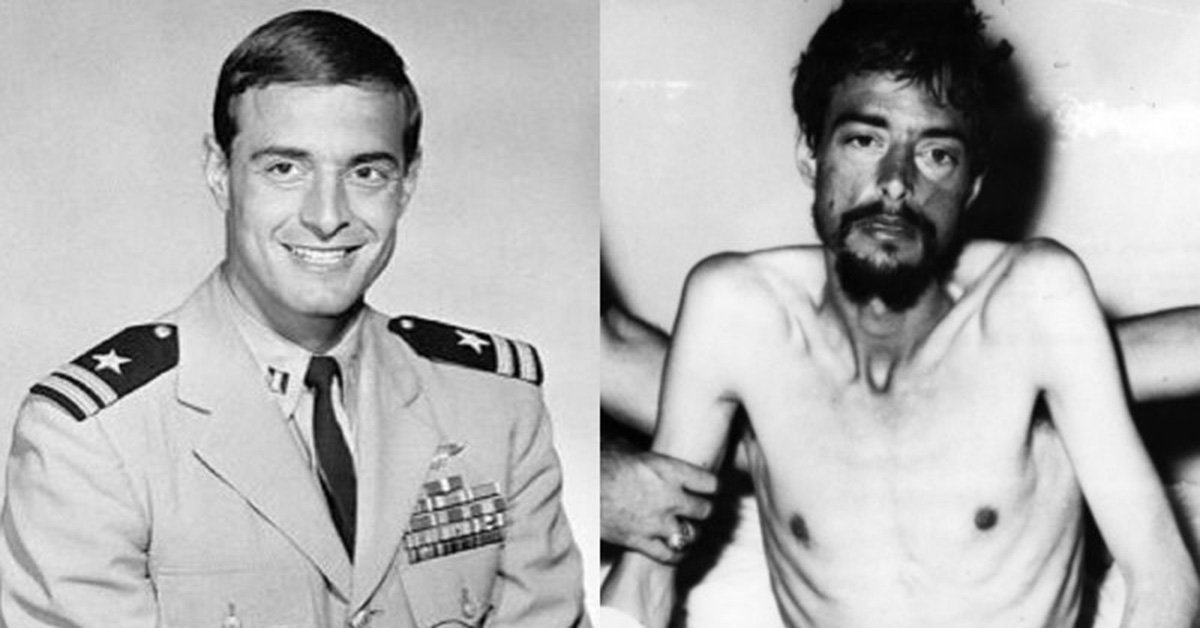
Dengler, who was presented with the Navy Cross, lost 59 pounds in captivity. At the time he was found, he weighed a skeletal 98 pounds and malaria, hepatitis, and intestinal worms ravaged his body.
The first night after his discharge from the hospital, typical of the way he lived his life, Dengler went to a nightclub. He and his wife went on to open a German restaurant for one reason.
“So I will never be hungry again,” Dengler reportedly said.
Doctors diagnosed Dengler with amyotrophic lateral sclerosis (ALS), or Lou Gehrig’s disease, in 1999. He died by suicide on February 7, 2001, at the age of 62.
Don’t Miss the Best of We Are The Mighty
• How a sailor remembered 256 prisoners of war through song • A Medal of Honor recipient used a dud enemy mortar to save US troops during WWII • The Vietnam tank driver who ran into a burning tank to pull his friends out
This Navy aviator escaped his captors during the Vietnam War and lived to tell about it
Why the service academies deserve their own spot in March Madness
Mighty MilSpouse
Some military nonprofits are MIA at a time when families need them most
By Sara Jane Ginn
How a bidding war inspired a WWI veteran to push for an NFL draft
‘Masters of the Air’ got a definitive new edition from The Folio Society