What South Korea’s Chunmoo rocket launcher has that HIMARS doesn’t
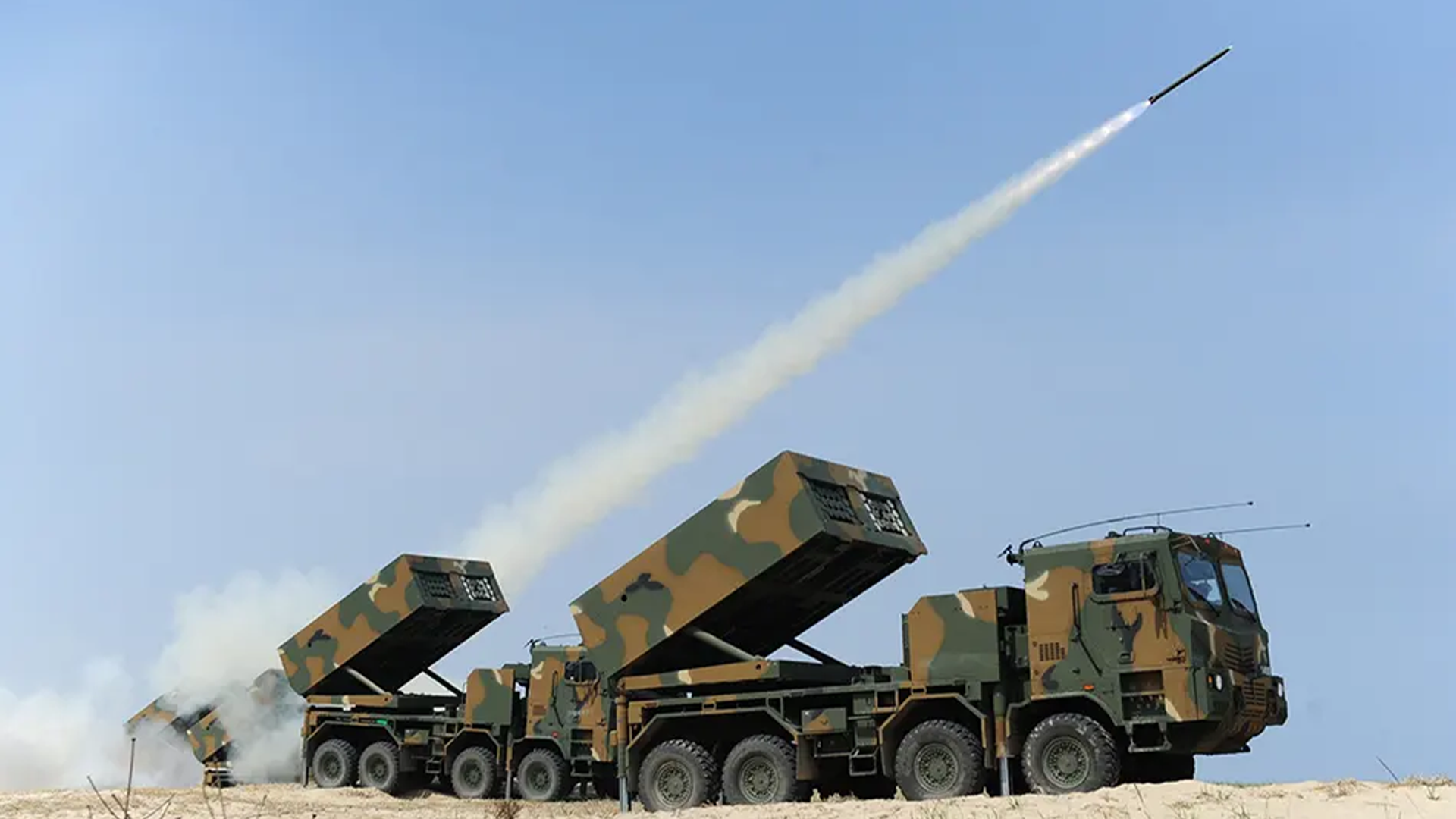
South Korea’s K239 Chunmoo Multiple Launch Rocket System (MLRS) is gaining popularity around the globe, particularly within NATO. Poland, Estonia, and Norway have all signed contracts with Hanwha Aerospace for the truck-mounted systems, and in Norway’s case, leaders picked it over the M142 High Mobility Artillery Rocket System, or HIMARS.
On paper, Chunmoo and HIMARS are very similar. Both are truck-mounted systems that can fire rockets with ranges out to 500 kilometers, and can be transported by aircraft as small as a C-130. The K239 requires a truck with 8 wheels, versus the HIMARS’ 6-wheel vehicle, but the South Korean system can carry double the rocket capacity of HIMARS. But that is where the major differences end.
So, why are countries picking Chunmoo over HIMARS? The answer comes down to what Hanwha Aerospace is really selling: Production agreements and fast delivery times.
Demand for MLRSs, particularly the combat-proven HIMARS, increased after Russia’s full-scale invasion of Ukraine put rocket artillery front and center. The ability to strike targets hundreds of miles away by using a highly mobile system is invaluable when drones prowl the battlefields. That demand has pushed the delivery times for HIMARS out to five years in some cases, and many customers aren’t comfortable waiting that long.
Poland’s recent efforts to beef up its rocket forces is maybe the clearest example of what the Chunmoo is really offering. In May 2022, Poland signed a letter of request for 500 HIMARS launchers. Lockheed-Martin makes the HIMARs system, but the Homar-A is a localized version assembled in Poland. These would complement a 2019 purchase of complete M142 systems that started showing up in 2023. As part of the agreement, Poland not only wanted to assemble the Homar-A in the country, but it also wanted to manufacture the GMLRS munitions locally.
Then, in October of 2022, Poland’s government started looking elsewhere after it became apparent there would be problems with both the number of systems they could purchase and how quickly they would arrive. Polish Deputy Prime Minister and Defence Minister Mariusz Błaszczak said, “We’re aware that we will not receive all 500 HIMARS launchers, for which we have sent a letter of request, within a timeline that would be satisfactory to us.” So, they signed a deal with Hanwha for 218 Chunmoo launchers.
Poland received the first batch of Chunmoo launchers for their locally-produced Homar-K in August 2023, less than a year after signing the contract. Since that first delivery, Poland and Hanwha’s relationship has deepened. The country ordered another 72 launchers in 2024 and, in December 2025, signed a deal to build the Chunmoo’s CGR-080 precision-guided rockets in a factory in Poland starting in 2030.
With the growth in maritime conflicts and threats to global trade, many countries are looking to bring defense manufacturing inside their borders. This not only reduces supply-chain risk but also wins political points at home for politicians with steady, good-paying jobs and a nation’s defense dollars kept within its borders.
But not every country is buying the hundreds of systems that make building a factory practical. Estonia, for example, purchased just six K239 systems from Hanwha in October of 2025 and another three in May of 2026. The central european country ordered six HIMARS in 2022, but they arrived three years later in April 2025. Leaders didn’t want to wait another three to five years for more HIMARS, so they went with Hanwha, which said it could deliver in the second half of 2027.
While Poland and Estonia chose Chunmoo to supplement their HIMARS fleet, Norway went all in on the South Korean system over HIMARS to build its rocket artillery forces from scratch. Officials there prioritized delivery time and purchased 16 Chunmoo in January 2026.
Norway’s decision was not necessarily about the Chunmoo being better than HIMARS. Instead, leaders picked the system that met the technical requirements, fit within budget, and could be delivered on a timeline the country found acceptable. Hanwha’s planned European ammunition plant in Poland also gives future Chunmoo users a supply chain that is not entirely dependent on South Korea.
That is the larger trend that systems like the Chunmoo are riding. With weapons becoming incredibly modular and software-agnostic, traditional strengths like fire-control systems no longer carry as much weight. Manufacturing, delivery timeframes, and support after the purchase are being prioritized by nations that don’t want to be left behind in the age of mobile rocket artillery. In France’s now-settled competition for a new MLRS, one of Lockheed Martin’s selling points was an 18-month delivery timeframe. Though they ultimately lost the competition to Safran, the schedule they put forward shows how important this is becoming.
Obviously, there is much more to this discussion, and we get deeper into it on our YouTube channel, so check out the video here and let us know what you think.
Related Legacy stories

This American flag survived D-Day, then was returned to the US 75 years later
When Howard Vander Beek died in 2014 at the age of 97, he left behind a distinct reminder of his World War II service. Vander Beek, a lieute
Medal of Honor recipient and legendary Vietnam War helicopter pilot ‘Old Snake’ has died
Retired Army Col. Bruce Perry Crandall, the legendary helicopter pilot who was awarded the U.S. military’s highest decoration for valor for
Air Force crew honors WWII-era Flying Tigers with A-10 paint job
It started as a routine transfer. Following an asset transfer from Korea, maintainers at Moody Air Force Base, Georgia, accepted and process