A veteran business’ hard-learned lessons on building—and rebuilding—a brand
Any veteran entrepreneur in business long enough probably feels like they’ve made every mistake in the book and paid for all of them. Chances are also good that they keep going anyway.
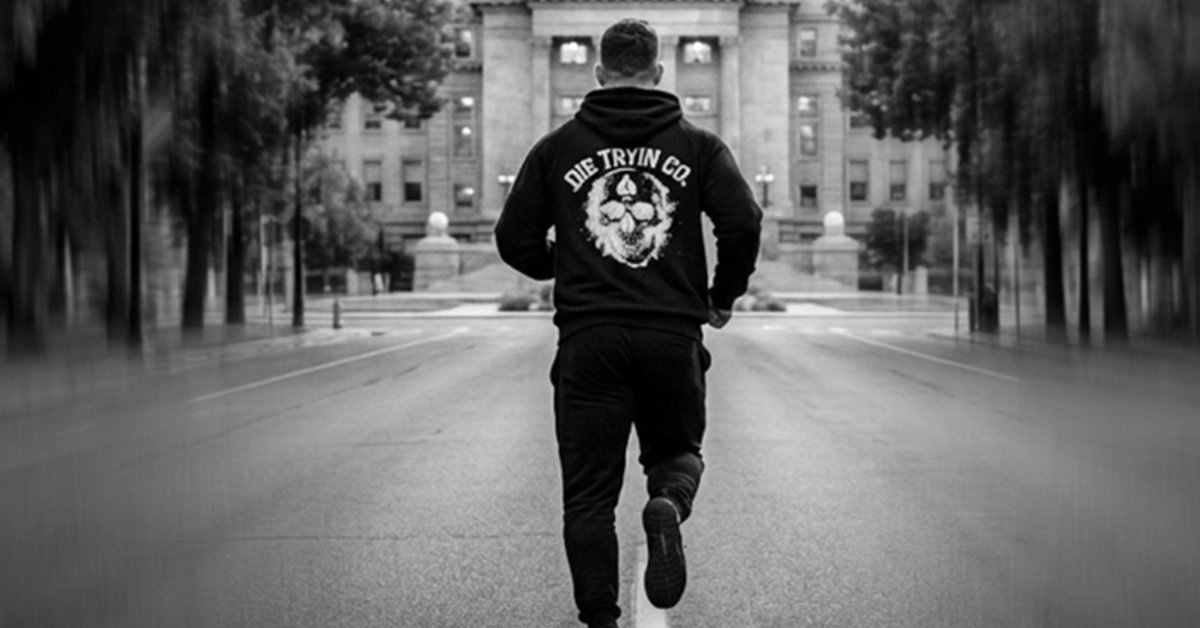
Jon Klipstein is no different. Ten years ago, he founded his workout supplement and apparel company as UXO, which he has since rebranded as Die Tryin Co. The rebrand was strategic, but not necessarily necessary—the Army veteran is working out of a 2,500-square-foot warehouse, not drawing a salary by choice, but still texting his business partner at 1 a.m. about product launches.
He wouldn’t have it any other way.
“It goes back to that mission statement,” Klipstein told We Are The Mighty. “Knowing why we started this company and believing in the product, believing in what we’re doing—that always continued to push me forward.”
The mission he’s talking about is to provide safe, effective supplement formulas while educating people on how to use them the right way. He founded the company after one of his soldiers died during a run after taking a dangerous pre-workout.
Klipstein’s story is one that more than 1.6 million veteran-owned businesses in America can probably relate to, even if the specifics vary. Veterans start companies for a lot of reasons, but the throughline is usually purpose. The military instills leadership, discipline, and mission-orientation—soft skills that translate well to entrepreneurship.
The problem is that the path from uniform to founder is rarely a straight line.
Klipstein deployed to Afghanistan in 2010, serving as an artillery crew member alongside a tight-knit group of soldiers who remain close to this day. When he took the uniform off and entered civilian life, the loss of identity hit hard. It’s a challenge researchers document time and again among the roughly 200,000 service members who separate from the military each year.
“You put that uniform on every single day, you served with a purpose, and you had meaning; you felt fulfilled,” he said. “Then you take that uniform off, and it’s like, ‘Who am I? What is my purpose now?’ Getting my first job right out of the military, that’s all that was. It was just a job.”
So he started a company.
What’s In a Name?
That company was originally called UXO Supplements, and Klipstein launched it out of his garage. Veterans probably know the business was named after the military term for unexploded ordnance. The brand leaned into its veteran roots from day one, something Klipstein now views as a double-edged sword.
“We were heavy on the veteran side and the focus of being veteran-owned,” he said. “We’ve seen other supplement companies enter the space, and they lean so heavy into the veteran ethos to where it almost becomes… pandering. For us, I know we have a quality product. I want us to be recognized first and foremost as a quality supplement company. The veteran-owned piece is the cherry on top.”
A business owner who later considered buying the company offered feedback that stuck with Klipstein for years.
“To you, UXO means something,” he’d told Klipstein. “To everybody else, it’s just a three-letter acronym. You need a name that people can connect with.”
The market bore out that advice. At CrossFit events, announcers kept pronouncing the name UXO as “Uhxoh.” At trade booths, Klipstein often spent 20 to 30 minutes explaining what the name meant to anyone who asked.
The problem wasn’t the product; it was the signal the brand sent before anyone even opened a container.
The $25,000 Question
Before he tackled the name, Klipstein made a more expensive error: he hired a branding agency.
The agency told him the original minimalist black labels weren’t going to move product. The answer, they said, was bright and flashy: labels that jumped off the shelf. Klipstein had a gut feeling it was wrong. He talked it over with his wife and his operations manager, Michaela. They had the same feeling. He went ahead with the redesign anyway.
“Deep down in my heart, I was like, ‘I don’t know if this is it,’” he said. “But it was almost like second-guessing yourself. That’s one of those times where I should have just trusted my gut.”
The customer reaction was swift. They hated the new look. The rebrand didn’t just fail aesthetically; it disconnected the company from its core audience. The blue-collar, military-veteran community energy that the original labels quietly communicated was gone.
This kind of mistake catches a lot of founders. The supplement space is brutally competitive, and access to capital remains one of the top challenges for veteran entrepreneurs. Some 75% of veterans cite it as a top barrier, and 72% rely on personal or family savings to fund their businesses.
When you’re bootstrapped, and someone with claimed expertise tells you to go a certain direction, it’s hard not to defer. Especially when you’ve already learned not to trust every instinct early on.
“I had to trust these guys,” Klipstein said. “This is what I’m paying them for.”
His trust cost him $25,000 and set the company back. He calls it a valuable lesson. That’s vet-speak for something that hurt like hell.
Die Tryin’
The failed redesign was ultimately the nudge Klipstein needed to address the name itself. This time, he did it right. He tested new label designs with a subset of loyal customers before committing.
He then went back to the business owner who’d once tried to buy UXO and asked him directly what he thought of the new direction.
“He said, ‘Dude, I love it,'” Klipstein recalled. “So we went all in.”
The new name, Die Tryin’ Co., is built around the “die trying” concept. And the difference has been tangible. Apparel sales surged. People who don’t even take supplements are buying Die Tryin’ gear because they connect with the mentality.
“We have a lot of people who don’t even take supplements that will buy the apparel,” Klipstein said. “They come across it, and they love the branding. They love the design. They love the message.”
That’s the ideal outcome of any rebrand: when the name starts doing marketing work on its own. But the success came with costs. Months after the rebrand, Klipstein was still running into people who hadn’t heard about it. Brand equity built over a decade under one name doesn’t automatically transfer.
View this post on Instagram
“There’s still people who don’t know. I met someone the other day at the gym, and they’re like, ‘Oh, I didn’t even know you guys rebranded,'” he said. “So now it’s getting the message out there and getting Die Tryin’ in front of everybody. Really telling that story.”
Back to the Usual Grind
For all the strategic lessons in Klipstein’s decade of building, the most relatable parts of his entrepreneurial efforts are about endurance.
He’s currently not paying himself. He also found an officially unofficial partner who wanted to develop a mushroom-based supplement. Onur Oncer is a fellow veteran who served alongside Klipstein in Afghanistan and he came on board to handle SEO for Die Tryin’ Co. (as well as develop the new mushroom product). Oncer isn’t getting paid either.
The two of them were texting about the business at 1 a.m. the night before this interview.
“When you are an entrepreneur, you have to wear all the hats, you have to work your ass off,” Klipstein said. “You’re not going to get paid in the beginning. I see us in the next year being in a position with the company to begin reaping the rewards of our hard work and sleepless nights.”
There are many veteran entrepreneurs who don’t know that kind of thing when they get into their first business. Lack of mentorship in the community is also a challenge. With 20% of veteran entrepreneurs citing the absence of mentors as a significant barrier, Klipstein’s early years of figuring things out the hard way aren’t unusual.
“We didn’t have a mentor,” he said. “We just had to learn from and chalk them up as losses and learned experiences.”
Cash flow in the supplement space is especially brutal: the product is paid for upfront, testing takes 12 to 16 weeks, and that money is tied up the entire time.
“Another lesson learned was burning the boats too soon,” he added. “I did step away from corporate America because we were making enough money and decided to go all in on UXO Supplements.
I was paying myself a salary for about three years, which allowed me to pay my bills and take care of my family. I made that decision too soon. I found out real quick that money was starving the business, when we could be injecting it into marketing and systems that would help it grow.”
For capital, he’s considered loans, walked away from investors who didn’t bring enough to the table beyond a check, and watched a potential acquisition fall through—something he now views as fortunate.
“Entrepreneurs getting started have to be comfortable with not getting a paycheck to do what is right for the business,” he said. “It’s like a kid who needs to be nurtured and developed. Obviously, they have to walk that thin line between sacrifice and insanity. Sometimes I feel like I’m over that line. But everyone’s road to success is a little different.”
Die Tryin’ Co. originally started with a $10,000 check. It now carries $200,000 in inventory and is preparing to move into a new warehouse double the size of the current one.
“We started this company with ten grand,” Klipstein said. “That’s the stuff that motivates me. I always tell people, never look back. You always have to look forward. But sometimes you have to look back to see how far you’ve come.”
To learn more about Die Tryin’ Co. or to buy some of Klipstein’s products, check out the website. All the ingredients are clearly labeled, and even newcomers can feel good about the safety of the supplements they’re buying.
Think of it as having a good NCO watch over you at the gym.
Don’t Miss the Best of We Are The Mighty
• The best online colleges for veterans in 2026, according to US News and World Report • The hidden costs of service and why military families are always starting over • Everything you need to know about using the GI Bill with other financial aid
A veteran business’ hard-learned lessons on building—and rebuilding—a brand
Real military captains drive Jeep’s ‘Captains of America’ commercial
Wanna make movies? Here’s a way to start for a dollar.
5 easy ways to support veteran-owned local businesses
Vietnam vet Bill Roedy left the Army for cable TV—and helped win the Cold War
Related Service stories

Yes, I Served in Iraq. But What if People Mistake Me for a Hero?
Illustration by Kim Vo The Department of Motor Vehicles was a good place to lose your identity, not find it, especially 30 minutes before cl
Officers only: New report lays out what a ‘US Cyber Force’ could look like
A new report argues that an independent Cyber Force should be staffed by only commissioned officers and warrant officers to better develop t
Navy researchers find wreck of World War II submarine that vanished 82 years ago
Nearly 82 years to the day after the USS Herring went missing during World War II, the Navy said it had found the wreck of a submarine that