An all gain, no pain infantry-ready workout, from beginner to advanced
Walk into any commercial gym, anytime, anywhere, and as you scan the main area, you begin to realize you are watching something unfold, a slow-motion tragedy lit by fluorescent lights: People chasing a body that looks great with an Instagram filter, but will fold like a newbie poker player the second you ask it to do something functional.
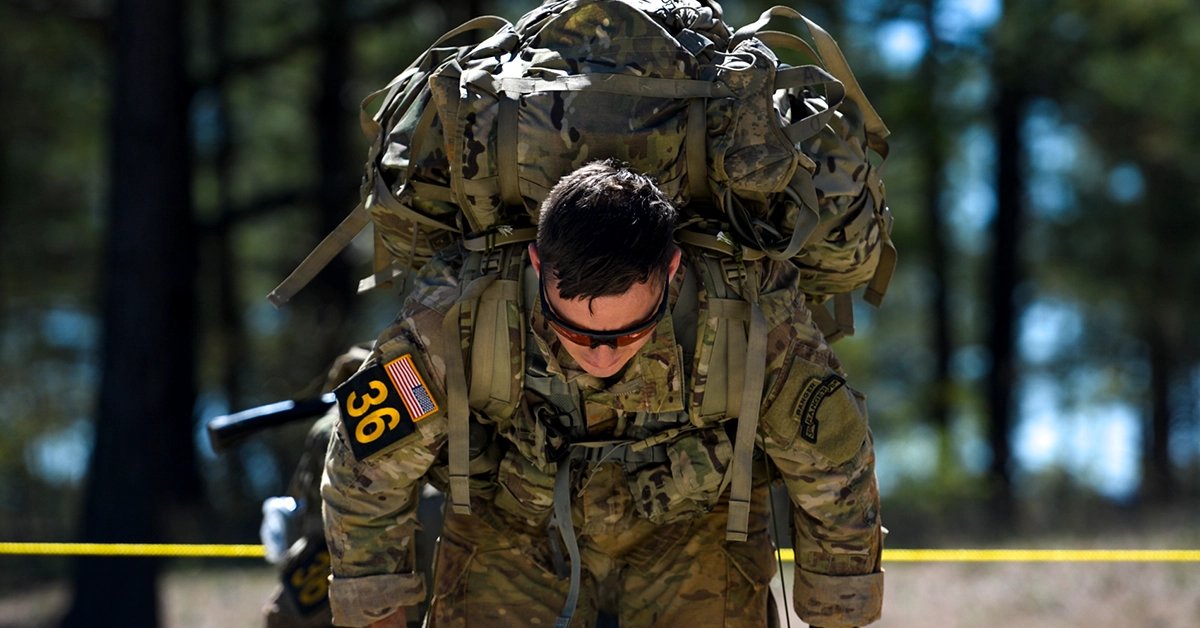
Infantry has zero use for that type of body. The job is not to be admired, although ‘miring can occur occasionally. The job is to carry a stupid amount of weight a long way over terrible ankle-eating terrain, then still be able to fight, dig, or drag a buddy to cover at the end of it.
You are training to be a beast of burden that can also tank its way to victory in combat, or run 2 miles in short shorts.
Here is the number that should reorganize your priorities. Army and Marine doctrine calls a fighting load about 48 pounds and an approach-march load about 72 pounds. In real life, those climb north into the 80s, 90s, and past 120 pounds once you pile on water, ammo, batteries, maybe some of that gear you purchased from the PX.
The benchmark every grunt knows is the ruck standard: 35 pounds, 12 miles, under three hours. That is a 15-minute mile with a loaded pack the entire way.
Now, the good news applies whether you are already an animal or a guy who gets winded fighting a fitted sheet. You build this body the same way at every level; pick the right work, then do slightly more of it than is comfortable, basically forever. That is progressive overload: the one rule to rule them all since Milo of Croton tossed a baby cow onto his shoulders and carried it until it was a scared full-grown bull.
Everything below is organized into three stages to safely build or rebuild a foundation: beginner, intermediate, and advanced. Find yours and go sweat.
If you do exactly one thing on this list, go rucking. Nothing on the planet builds infantry conditioning like the infantry’s signature hobby, which is walking absurd distances while wearing and carrying all the gear. It is boring and tedious, and the impatient injure themselves into a medical discharge.
Beginner Put almost nothing in the bag. Ten to 15 pounds, flat ground, half an hour, two or three times a week, and do not run, because jogging under load right now turns your knees into a future VA disability rating.
You are not training yet. You are sending your feet, ankles, and hips a memo that the easy years are over. Try to keep the heaviest items at the top of your bag; this will help prevent a slipped disc in your back from eventually digging into a nerve for 4-6 weeks of your life.
Intermediate Incremental overload is key. Creep the weight toward 30 pounds, then 35, or push the distance to 3 to 5 miles. Learn what the initiated call “the shuffle,” a flat-footed glide that is better than walking too slow but excellent for joint preservation. The goal here is to hold a 15-minute mile and let the discomfort become background noise.
Advanced Carry what the job carries: 45 pounds and up, 6 miles and beyond, hills, bad footing, and the occasional timed crack at the full 12-mile, 35-pound, three-hour standard, because guessing where you stand is for amateurs. Finishing a ruck was never the goal. Finishing one and still being useful is.
Lungs First, Abs Later
You can be as strong as an ox and still be useless if you redline on the first hill, then blow out an O-ring. Conditioning is what lets you do hard things back to back instead of doing one hard thing and then finding yourself facedown in the dirt. Build it in the right order or waste a season hating cardio and neglecting your heart.
Beginner Go slow, almost embarrassingly so. You’ll aim to hold a full conversation while you jog or briskly walk for 20 to 30 minutes, several times a week. It will feel like you’re cheating. You are not. That easy aerobic base is the foundation on which every milestone gets stacked; skipping it is exactly why people stall out and blame their parents’ scrapple genes for their failure.
Intermediate Keep the easy days and add one weekly hard effort; aim for 20 minutes at an annoying but doable pace, plus one longer slow grind that will eventually become an active rest day.
Here is where you begin stretching the distance between your new cruising speed and your top end.
Advanced Discomfort is gain; pain, on the other hand, is a potential setback. Short, vicious intervals, 400s and 800s at a pace that makes the sky look interesting, with just enough rest to do it again but hate it in a good way. If you can still hold a conversation at the finish, you went for a jog, reset, and get after it again.
Infantry fit is not for the mirror, although that is a happy byproduct. It is for standing up under a loaded pack instead of wilting beneath it, and for being the guy who picks up others instead of the guy getting picked up.
Train movements, not muscles, and earn the barbell by first running your own bodyweight cleanly. Movements that matter most are squat, hinge, push, pull, carry, and core. Now, you can’t spot-reduce trouble areas; however, you can progressively overload each one.
Beginner Own your own body first: Squat down onto a chair, do push-ups from your knees, perform planks anywhere, and do a 30-second walk holding light dumbbells. Sound boring? It might be, in the beginning. Is it effective? Right on. If you cannot move your body cleanly, jacking up an overloaded barbell only makes the eventual wreck more diabolical.
Intermediate Add some load. Goblet (dumbbell) then barbell squats, Romanian deadlifts, clean floor push-ups and dips, honest pull-ups, bent-over rows, and farmer’s carries heavy enough that your grip starts to give. Hit all six movements, then add a little weight every week or two or as needed when things get too easy.
Advanced Time for the fun stuff. Heavy squats and deadlifts in the low reps, weighted push-ups and overhead presses, weighted pull-ups, heavy rows, and sandbag carries that feel like wrestling an English Bulldog.
Train your core for readiness under load, never for abs, because abs are a souvenir, a consolation prize born of hard work and immaculate food discipline.
Goals, Not Clout
Two rules turn that smashup of exercises into a routine. The first is progressive overload, again, because people tend to forget the instant they hit the gym floor. Every week or two, add something, whether it’s a rep, a pound, an extra set, or a slightly heavier ruck.
Work that never gets harder builds a body that never gets stronger.
Second, a split so you are not nuking the same muscles daily. Push, pull, legs is the old reliable, one day pressing, one day pulling, one day squatting and hinging, on a loop, and it is plenty for anyone not getting paid to do this for a living. Some might also prefer a pull, push, legs split, do whatever you enjoy most.
At home, a set of adjustable dumbbells or a couple of kettlebells, a doorway pull-up bar, a sandbag, and the ruck already in your closet will take you embarrassingly far.
At a brick-and-mortar gym, live on the barbell lifts and the handful of machines that earn their floor space, the leg press, chest press, the lat pulldown, the cable row, and the shoulder press. You can stroll right past the contraptions built to inflate one muscle you will never use to carry anything heavier than your emotional baggage.
Spread it Like Peanut Butter Jelly
This whole thing collapses in on itself, like a dying star collapsing under too much shame, if you cram it into three hero days and spend the rest of the week imitating a baby deer walking for the first time.
Spread the grind as if it’s your brunch hummus over avocado toast.
Beginner Spread over four days: two easy rucks or walks, one full-body bodyweight session, one easy cardio day, and a generous amount of couch. You are building tissue and tendons that tolerate work; you don’t want any snapping, crackling, and/or popping to occur in any of your joints.
Intermediate Spread over five days: two rucks of escalating weight, two lifting days that split push from pull-and-legs, and a pair of runs, one easy or one tempo.
Advanced Spread it over six days; utilize heavier and longer rucks, a true push-pull-legs rotation, base runs and intervals on separate days, and one genuinely nasty effort a week to find your limits. Guard your sleep like the last bag of gummy bears, because that is when the improvement actually happens.
Whatever your level, never attach your hardest ruck day near your heaviest leg day. Soreness is not a “weakness leaving your body;” it’s your body pumping lactic acid into your muscles to stop you from hurting yourself badly. The fastest way out of this plan is to cause an injury that could have been avoided by listening to your body.
Gains, Not Pains
Recovery is the part where the getting better actually happens, and treating it as optional is a mistake many have made. Look out onto the fitness battlefield and see the area littered with torn ACLs and tendons snapped right off the bone.
Beginner Do the dull stuff. Seven to nine hours of sleep, real rest days, drink water like it is your actual job, and a few minutes on a foam roller, which feels like a demon smooshing a knot out of your thigh and works so well it’ll make you cry.
Roll the quads, calves, and upper back until the tension finally taps out.
Intermediate Add mobility for the joints the infantry beats up, the hips, the ankles, and the upper back, you rounded over a decade of hunching over your meals like a greedy raccoon, and end sessions with static stretches held 30 seconds or longer. No bouncing. You are not auditioning for a music video.
Advanced Program your rest like you program your training regimen. Schedule an easy deload week about once a month, before your body schedules a forced one with an injury, add prehab for the joints that already talk back, and learn to tell the honest burn of a worked muscle from the sharp little signal that something is about to give.
When you feel that signal, back off: ego is a lot cheaper to swallow than surgery.
None of this is complicated. It is just heavy, repetitive, and gloriously unfashionable. Pick your level, do the work that is a hair harder than yesterday’s, sleep, eat, repeat, and one day the pack that used to flatten you will feel like part of your spine. You might not earn a tank-top physique but you will earn something better: a body that gets sh*t done and refuses to quit when someone is counting on it.
Don’t Miss the Best of We Are The Mighty
• The M72 LAW: the tube that toughened the infantry • The infantry hates the XM7 rifle (and why the Army doesn’t care) • Audie Murphy’s Medal of Honor action is still like something out of a movie
An all gain, no pain infantry-ready workout, from beginner to advanced
Herbert Hoover embraced ‘Hooverball’ to stay fit amid economic turmoil
By Daniel Tobias Flint
Installation fitness programs you might not know about
7 military discounts for your fitness journey
This soldier created SickFit apparel and socks to outlast the toughest rucks
Related Service stories

Yes, I Served in Iraq. But What if People Mistake Me for a Hero?
Illustration by Kim Vo The Department of Motor Vehicles was a good place to lose your identity, not find it, especially 30 minutes before cl
Officers only: New report lays out what a ‘US Cyber Force’ could look like
A new report argues that an independent Cyber Force should be staffed by only commissioned officers and warrant officers to better develop t
Navy researchers find wreck of World War II submarine that vanished 82 years ago
Nearly 82 years to the day after the USS Herring went missing during World War II, the Navy said it had found the wreck of a submarine that