The Cuban Missile Crisis: 13 days that almost ended the world
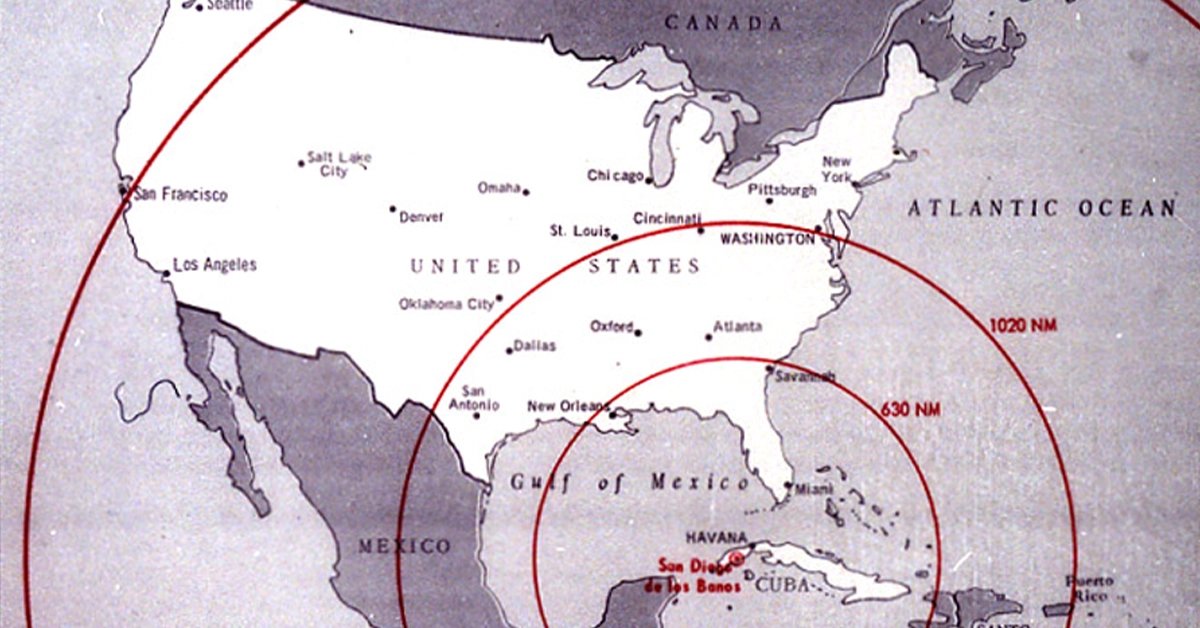
The Cuban Missile Crisis was an entirely avoidable, but potentially deadly period in Cold War history. In 1946 George Kennan, an American diplomat in the Soviet Union, sent a telegram to President Harry S. Truman’s State Department about his view of the USSR’s aggression. It would come to define the United States’ relationship with the Soviets for the next 45 years.
Kennan wrote that the Soviets were “impervious to logic of reason… highly sensitive to the logic of force.” This outlook became the cornerstone of U.S. “containment” policy against Soviet and communist expansion, a policy which led both countries to the brink of global nuclear war 16 years later.
Because of the failed Bay of Pigs invasion of Cuba in 1961, and the presence of U.S. nuclear missiles in Turkey and Italy starting in 1959, Cuban leader Fidel Castro and Soviet Premier Nikita Khrushchev agreed to place nuclear missile installations in Cuba to deter any future invasion attempts by the U.S. and the Central Intelligence Agency to invade Cuba.
The CIA was tipped off by Soviet spy Colonel Oleg Penkovsky, who passed on war plans, secret documents, and other human intelligence. On Oct. 14, a U-2 spy plane overflight confirmed the presence of Soviet missiles on Cuba. For the next 13 days, Oct. 16 to 28, 1962, the U.S. and Soviet Union faced each other down in a confrontation that would be the closest the world came to nuclear annihilation during the Cold War.
16 October: The president is informed about the photographic evidence
President John F. Kennedy was notified of the presence and confirmation of Soviet missiles in Cuba and received a full intelligence briefing. Two response ideas were proposed: an air strike and invasion or a naval quarantine with the threat of further military action.
Kennedy kept to his official schedule to avoid raising concerns from the public.
17 October: U.S. troops begin buildup in the Southeast
Military units flowed into bases in the Southeastern states. U-2 reconnaissance flights showed continued development of missile sites in Cuba, complete with medium and long range missiles, capable of hitting most of the continental United States. The president met with the Libyan head of state and then went to Connecticut to support political candidates.
18 October: The Soviet Foreign Minister meets with Kennedy
Foreign Minister Andrei Gromyko met Kennedy at the White House, assuring the president the weapons were defensive. Kennedy knew otherwise but didn’t press the issue, instead giving Gromyko a warning of “gravest consequences” if offensive nuclear weapons were on Cuba.
19 October: Business as usual
The president stuck to his scheduled travel in the midwestern United States. Advisors continued to debate a response strategy.
20 October: Kennedy orders a “quarantine” of Cuba
The White House called the blockade a “quarantine” because a blockade is technically an act of war. Any Soviet ships carrying weapons to Cuba would be turned back. Kennedy faked a cold as an excuse to end his trip early without alarming Americans and returned to Washington.
21 October: Tactical Air Command cannot guarantee destruction of the missiles
Kennedy attended Sunday Mass then met with Gen. Walter Sweeney of the U.S. Air Force Tactical Air Command. Sweeney could not guarantee 100% destruction of the missiles.
22 October: Kennedy informs the public about the blockade and puts U.S. troops on alert
Kennedy informs former Presidents Hoover, Truman, and Eisenhower as well as the British Prime Minister Harold Macmillan on the Cuban Missile Crisis (though it wasn’t officially called that). He then assembles and Executive Committee (EXCOMM) of the National Security Council to work out coordinating further action.
After a week of waiting, the president addressed the nation to inform them about the presence of Soviet missiles on Cuba. He also announced the quarantine of the island to prevent further “offensive military equipment” from arriving, stating the U.S. will not end the quarantine until the USSR removes the missiles.
The EXCOMM assembled by President Kennedy recommended a military invasion of Cuba to end the stalemate, which would have led to massive retaliation from the Soviet Union, and the destruction of all forces on the island. The U.S. moved to defense condition (DEFCON) 3.
“I have not assumed that you or any other sane man would In this nuclear age, deliberately plunge the world into war which it is crystal clear no country could win and which could only result in catastrophic consequences to the whole world, including the aggressor,” Kennedy wrote to Soviet Premier Nikita Khrushchev.
23 October: Organization of American States (OAS) Supports Quarantine
The OAS support for the blockade gave the American move international legitimacy. Cuba was expelled from the OAS earlier in 1962. U.S. ships moved into their blockade positions around Cuba. Soviet freighters bound for Cuba with military supplies stopped for the most part but the oil tanker Bucharest continued to Cuba.
Attorney General Robert Kennedy met with Ambassador Anatoli Dobrynin at the Soviet Embassy.
24 October: Khrushchev denounces the quarantine
The Soviet Premier denounced the U.S. quarantine of the island as an act of aggression.
“You, Mr. President, are not declaring a quarantine, but rather are setting forth an ultimatum and threatening that if we do not give in to your demands you will use force,” Khrushchev wrote. “Consider what you are saying! And you want to persuade me to agree to this! What would it mean to agree to these demands? It would mean guiding oneself in one’s relations with other countries not by reason, but by submitting to arbitrariness. You are no longer appealing to reason, but wish to intimidate us.”
Pope John XXIII appealed to Kennedy and Khrushchev to push for peace.
25 October: Adlai Stevenson presents evidence of missiles in Cuba to UN
The United States requested an emergency meeting of the UN Security council, where the Soviet ambassador denied the presence of missiles in Cuba.
American Ambassador to the United Nations Adlai Stevenson told the Soviet ambassador he was “willing to wait until hell freezes over” for an answer from the USSR. Then he showed the damning reconnaissance photos to the UN.
UN Secretary General U Thant called for a “cooling off” period, rejected by President Kennedy because it left the missiles in Cuba.
26 October: The U.S. Armed Forces prepare for all out war
The U.S. military moved to DEFCON 2. Once the blockade was in place, all Soviet ships bound for Cuba either held their positions or reversed course. Some ships were searched and allowed to proceed.
Missiles on Cuba became operational and construction continued. Soviet IL-28 bombers began construction on Cuban airfields. Fearing an imminent attack from the United States, Cuban leader Fidel Castro suggested to Khrushchev the USSR should attack first.
Soviet spy Aleksander Fomin approached ABC News’ John Scali to offer a diplomatic solution: The removal of the missiles in exchange for a promise not to invade Cuba.
The Khrushchev sent a letter with a similar message to President Kennedy stating his willingness to remove the missiles from the island if the United States would pledge never to invade Cuba.
27 October (Black Saturday): Khrushchev offers a new deal to Kennedy
In a second, more harshly worded letter, the Soviet leader agreed to withdraw the missiles if Kennedy promised to never invade Cuba and to remove American Jupiter missiles from Turkey, contradicting his personal letter to Kennedy.
A U-2 spy plane checking the progress of the missiles was shot down over Cuba, killing the pilot, Maj. Rudolph Anderson. Neither side escalated the conflict, despite the shootdown.
The U.S. ignored Khrushchev’s public offer and took him up on the first offer, adding they would voluntarily remove the Jupiter missiles from Turkey a few months later, voluntarily.
A U.S. Navy ship dropped depth charges at a Soviet submarine under the blockade line. The submarine was armed with nuclear torpedoes, but chose not to fire them in retaliation. Meanwhile, an American plane was chased out of Russia’s Kamchatka region by Soviet MiGs.
In the evening, the USSR and USA, through Robert Kennedy and Soviet Ambassador Dobrynin, reached an agreement to de-escalate the conflict.
28 October: The USSR announces it will remove missiles from Cuba
The Soviets agreed publicly to remove the missiles in exchange for the promise not to invade Cuba, effectively ending the Cuban Missile Crisis. They do not mention the agreement to remove U.S. missiles from Turkey.
Radio Moscow announced that the Soviet Union accepted the proposed solution and released the text of a Khrushchev letter affirming that the missiles would be removed. The missiles were loaded and shipped back to the Soviet Union in early November 1962.
By the end of November, the U.S. embargo on Cuba ended. Soviet bombers left the country before the end of the year and the Jupiter missiles were removed form Turkey by the end of April 1963. A “hotline” was set up between the USSR and the United States to ensure direct communication between the two superpowers in the future.
Don’t Miss the Best of We Are The Mighty
• The Cold War’s deadliest CIA mole completes life sentence • 7 unbelievable secret spy weapons of the Cold War • The tiny Cold War helicopter the Marines almost took into combat
The Cuban Missile Crisis: 13 days that almost ended the world
World War II
The USS Devilfish suffered the only kamikaze attack on a US submarine
The US military’s drinking water was the worst water you’ve ever loved
Trailblazing Vietnam veteran helped reveal how humans came to be
Before 3 tours in Vietnam, this fighter pilot dropped nearly 20 miles from high above
Related Legacy stories
This American flag survived D-Day, then was returned to the US 75 years later
When Howard Vander Beek died in 2014 at the age of 97, he left behind a distinct reminder of his World War II service. Vander Beek, a lieute
Medal of Honor recipient and legendary Vietnam War helicopter pilot ‘Old Snake’ has died
Retired Army Col. Bruce Perry Crandall, the legendary helicopter pilot who was awarded the U.S. military’s highest decoration for valor for
Air Force crew honors WWII-era Flying Tigers with A-10 paint job
It started as a routine transfer. Following an asset transfer from Korea, maintainers at Moody Air Force Base, Georgia, accepted and process