This Medal of Honor recipient turned on his helicopter lights during a risky rescue in Vietnam
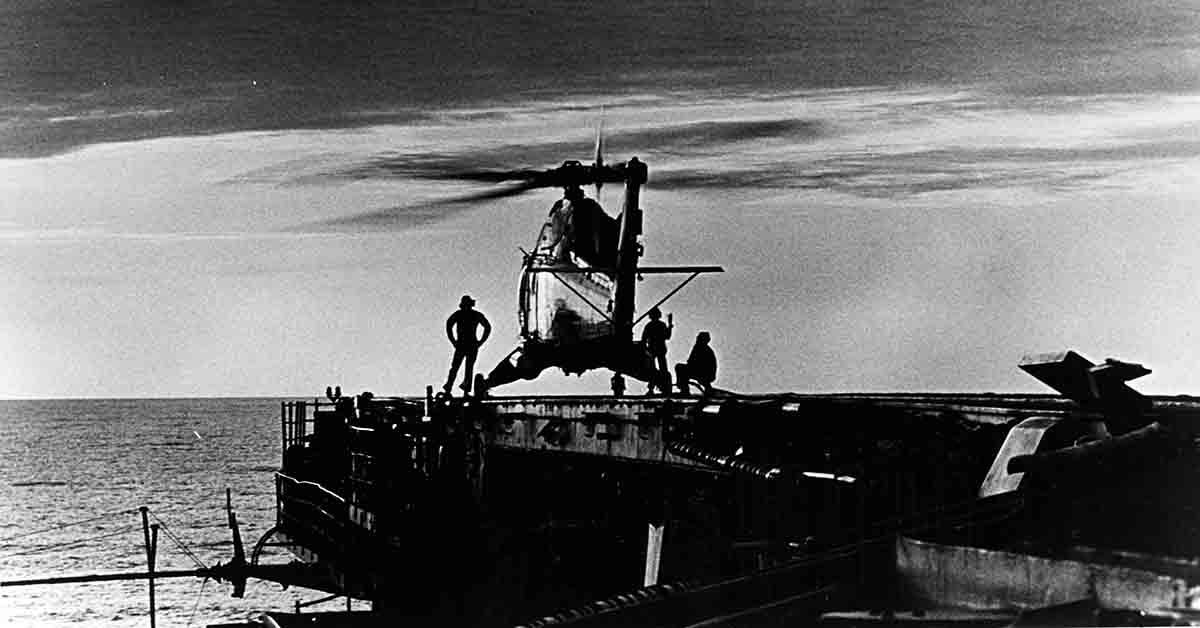
For the rest of his life, Clyde Lassen rarely spoke of the night of June 19, 1968.
A private man, Lassen—who achieved the rank of commander during his two decades in the United States Navy—kept the harrowing details largely to himself. He rarely opened up, even to his own family. His two children did not even obtain a complete picture of their father’s heroism until a half-century later.
Lassen didn’t have to say much. On that incredibly dangerous night, Lassen piloted a UH-2A Seasprite search-and-rescue helicopter and extracted two downed aviators in hostile territory during the Vietnam War. The successful mission earned Lassen the Medal of Honor.
2 Navy Aviators Down
Lassen, whose father served during World War II, was in junior college when he enlisted in the Navy in 1961. He began his military career as an aviation electronics technician, but he didn’t find that type of work fulfilling.
Lassen wanted something more stimulating, and flying appealed to him. He secured a spot in the Naval Aviation Cadet Program and received his commission in 1965. Lassen eventually found his way to Helicopter Support Squadron 7 on the USS Preble. That was where Lassen and his crew learned that two naval aviators were in trouble.
John Holtzclaw and John Burns ejected from their F-4J Phantom II fighter jet after a surface-to-air missile struck it. They went down deep in enemy territory. The aircraft that Lassen flew, a UH-2A Seasprite, wasn’t ideal for this extraction. As historian Hill Goodspeed explained in a Navy History and Heritage Command article, the helicopter was heavy and couldn’t fully fill its fuel tanks.
Lassen took off shortly after midnight anyway. Despite enemy fire, the then-lieutenant junior grade managed to land in a clearing at the base of a steep hill covered with trees. Holtzclaw and Burns, who broke his leg during the ejection, couldn’t make it down the slope, so Lassen took the Seasprite airborne again.
He wasn’t done trying.
Flares Keep Going Out
Lassen’s crew made radio contact with the downed aviators and requested they send up flares to reveal their position.
Once they did, Lassen guided his helicopter into a hover roughly 50 feet above their location. Lassen planned to hoist them out of North Vietnam, but the flares went out before he even attempted it.
In the air in the middle of the night with no lights, Lassen was vulnerable.
“I added power and was just starting a climb when I hit the tree,” Lassen recalled in Goodspeed’s article. “I felt a large jolt, and the helo pitched down and went into a tight starboard turn. I regained control and waved off.”
The Seasprite descended sharply after the collision, according to Lassen’s Medal of Honor citation, but the fearless pilot remained airborne. With the amount of enemy fire, they didn’t have the luxury of staying in one place very long. As they called for another aircraft to bring flares, Lassen and his crew encouraged Holtzclaw and Burns to approach the clearing if they could.
Lassen’s second attempt to land failed. He was not disheartened, only more determined to rescue Holtzclaw and Burns. His next try ended when the substitute flares went out.
Lassen was running short of fuel.
Running Out of Options
He couldn’t wait for more flares, and it was almost completely dark so he turned on his landing lights. While that allowed him to see the desperate Holtzclaw and Burns, it also exposed his helicopter’s position.
Lassen hovered the Seaspite over a rice paddy for a couple of minutes as his gunners, Donald West and Bruce Dallas, fired their machine guns into the trees. As the downed aviators approached Lassen’s helicopter, Dallas quickly pulled them into the aircraft.
“I really started to get antsy from the time we got them on board,” Lassen recounted to Goodspeed. “That was the only time I really thought we weren’t going to make it.”
The Seasprite sped away from anti-aircraft fire as fast as possible. It wasn’t until the helicopter landed on the USS Jouett that the crew, Holtzclaw, and Burns exhaled. Despite facing a barrage of enemy fire, they discovered only one bullet hole in the aircraft. It sustained some scrapes and lost a door during the rescue, but otherwise, the helicopter held up well.
So did everyone involved.
“Something to Do”
Goodspeed relayed the story of how Burns approached Lassen on the USS Jouett and tapped him on the shoulder.
“I don’t know how to say this…,” Burns began before Lassen cut him off.
“You know, we’ve been over here for a couple of months, and we haven’t had a damn thing to do,” Lassen said. “It was nice to have a little something to do tonight.”
President Lyndon B. Johnson presented Lassen with the Medal of Honor at the White House on January 16, 1969.
Lassen, who retired from the military in 1982, died of cancer in 1994 at the age of 52. The Navy commissioned the Arleigh Burke-class, guided-missile destroyer USS Lassen in his name in 2001.
Don’t Miss the Best of We Are The Mighty
• How Ronald Reagan healed scars from Vietnam on Memorial Day in 1984 • This Navy aviator escaped his captors during the Vietnam War and lived to tell about it • Retired Marine colonel to lead NASA’s Artemis III mission
This Medal of Honor recipient turned on his helicopter lights during a risky rescue in Vietnam
How the Vermont National Guard scored the first major victory against the British
The ‘Iron Division’ of World War I came from the Pennsylvania National Guard
This National Guard unit fought alongside Marine Raiders in the Pacific
World War II
The story of the only US soldier executed for desertion since the Civil War
Related Legacy stories
This American flag survived D-Day, then was returned to the US 75 years later
When Howard Vander Beek died in 2014 at the age of 97, he left behind a distinct reminder of his World War II service. Vander Beek, a lieute
Medal of Honor recipient and legendary Vietnam War helicopter pilot ‘Old Snake’ has died
Retired Army Col. Bruce Perry Crandall, the legendary helicopter pilot who was awarded the U.S. military’s highest decoration for valor for
Air Force crew honors WWII-era Flying Tigers with A-10 paint job
It started as a routine transfer. Following an asset transfer from Korea, maintainers at Moody Air Force Base, Georgia, accepted and process