10 life lessons that William McRaven learned in Navy SEAL training
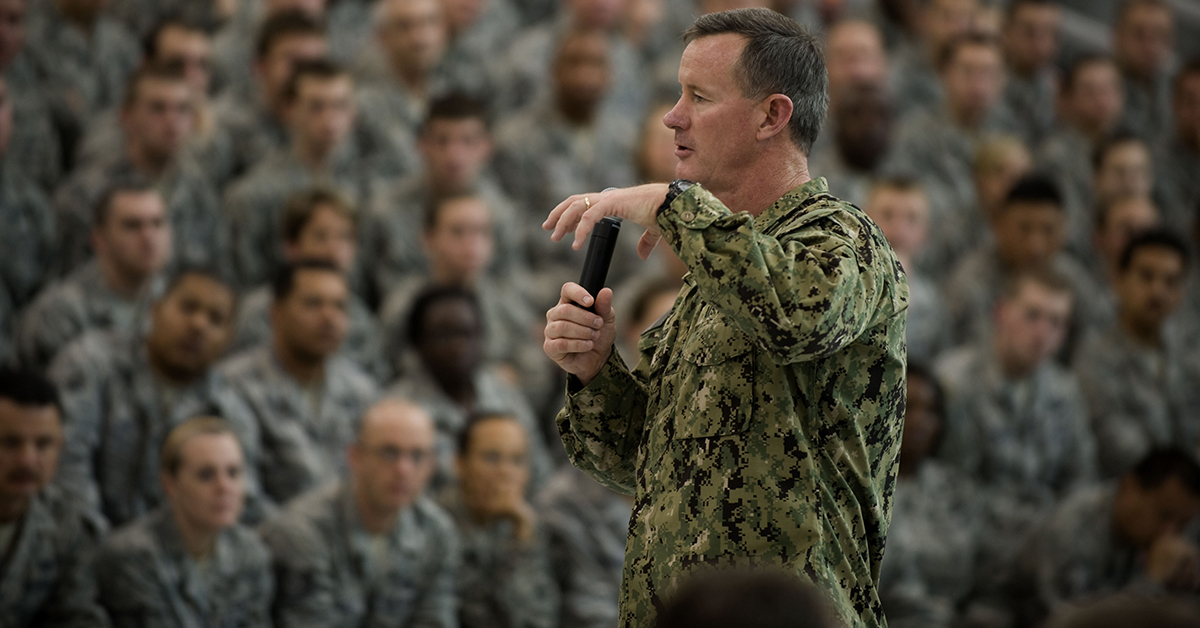
On the same day that William McRaven graduated from the University of Texas in 1977 with a degree in journalism, he received his commission into the United States Navy.
That day was a highlight of McRaven’s young life. Many more followed as McRaven became a four-star admiral and commander of United States Special Operations Command from 2011 to 2014.
A few months before McRaven’s time leading USSOCOM ended, he returned to his alma mater and delivered the spring commencement address. McRaven’s message to the newly minted graduates was that they possessed the ability to change the world.
McRaven took the audience back to early in his 37-year military career. Here are 10 things that McRaven learned in Navy SEAL training that, he told his audience, shaped his life.
1. Make Your Bed
Every morning in Basic Underwater Demolition/SEAL training began the same way for McRaven and the other candidates. Instructors inspected their bed to ensure it was made properly.
In time, McRaven learned the value of this lesson. The small details matter. Making one’s bed properly day after day becomes a habit, provides a small sense of accomplishment, and hones an attention to detail that is useful on larger, more important missions or projects.
“It seemed a little ridiculous at the time, particularly in light of the fact that we were aspiring to be real warriors, tough, battle-hardened SEALs,” McRaven told the roughly 8,000 soon-to-be graduates in attendance. “But the wisdom of this simple act has been proven to me many times over.”
2. It’s Harder to Paddle Alone
During training, instructors divided SEAL candidates into boat crews. Each boat consisted of six students and a coxswain to guide them through the challenging surf off San Diego—near the Naval Special Warfare Center in Coronado, California.
McRaven informed the crowd that the exercise involved the prospective SEALs paddling several miles. It wasn’t easy, but it was doable as long as those in the boat synchronized those strokes and listened to the coxswain.
McRaven’s message: No one achieves success by themselves.
3. Don’t Underestimate the Munchkins
It wasn’t long before the instructors didn’t need as many boats for their students. McRaven’s class started with 150, and after a few weeks, only 42 candidates remained. That left only six boats.
McRaven said the most proficient crew was also the most unlikely. Because no one in the top boat was taller than 5 feet, 5 inches tall, they earned the nickname “the Munchkin crew.” The Munchkins got the job done, usually outperforming the other crews.
McRaven called SEAL training the great equalizer.
“Nothing mattered but your will to succeed,” he said. “Not your color, not your ethnic background, not your education, not your social status.”
4. Everyone’s a ‘Sugar Cookie’ at Some Point
At some point, every SEAL candidate fails a uniform inspection.
When that inevitability occurs, instructors force them to roll around in the surf until a layer of sand coats their entire bodies. In the process, they become a “sugar cookie,” and what’s more, the students couldn’t wash off those annoying grains of sand until the end of the day.
As McRaven said at the University of Texas, some students couldn’t understand why their uniform didn’t pass inspection. Believing they did everything right, they focused on the perceived injustice.
McRaven said they missed the point.
“The instructors weren’t going to allow [a perfect uniform],” McRaven said. “Sometimes, no matter how well you prepare or how well you perform, you still end [up] as a sugar cookie.”
5. Embrace ‘the Circus’
A day didn’t pass during BUD/S without the candidates enduring a bunch of physical training. The instructors established standards, and failing to meet those benchmarks meant joining “the circus.”
That wasn’t a good thing, and it was usually unavoidable at some point. The circus involved two more hours of calisthenics that were intended to wear down students so much that they quit.
McRaven noticed something interesting for those who repeatedly rejoined the circus. Their shared pain made it more bearable, and if you survive the tough times, you will emerge from them stronger.
“Life is filled with circuses,” McRaven said. “You will fail. You will likely fail often. It will be painful. It will be discouraging. At times, it will test you to your very core.”
6. Sometimes, You Have to Think Outside the Box
McRaven told the graduates about “the slide for life,” which was regularly part of the SEAL candidates’ obstacle course. The admiral described the slide as a 200-foot-long rope between a three-level tower at one end and a one-level tower at the other.
“You had to climb the three-tiered tower, and once at the top, you grabbed the rope, swung underneath the rope, and pulled yourself hand over hand until you got to the other end,” McRaven explained.
The long-standing record for the obstacle course finally fell one day when a candidate approached the slide for life differently. Instead of hanging underneath the rope, they navigated their way on top of it. It was very risky but ultimately successful.
Don’t be afraid to challenge the status quo, McRaven said.
7. Don’t Fear the Sharks
When SEAL candidates swam at night in the Pacific Ocean, instructors informed them about the nearby sharks. If one of them approaches you, McRaven and his fellow students were told, don’t act afraid or swim in the other direction. If a shark approaches you, hit him in the snout. Then the shark likely will go away.
“There are a lot of sharks in the world,” McRaven said. “If you hope to complete the swim, you will have to deal with them.”
8. Stay Levelheaded During Tough Times
McRaven said that during ship attack mission training, candidates swam a couple of miles to a ship tied to a pier. The success of the exercise rested with a prospective SEAL finding the keel underneath the ship.
The keel is also the darkest portion of the ship and very disorienting. A student will not pass if they don’t remain calm—even though everything around them screams panic.
“If you want to change the world, you must be your very best in the darkest moments,” McRaven said.
9. Don’t Ever Lose Hope
McRaven’s graduation speech wouldn’t be complete without mentioning Hell Week. During those sleep-deprived hours of physical and mental anguish, the candidates must survive the mud flats between San Diego and Tijuana, Mexico. When instructors ordered McRaven’s class in the mud during the nighttime cold, the candidates sank up to their necks in the muck.
The instructors gave the student an out. They could leave the mud behind if just five of them quit. Instead, one trainee started singing, then another and another until everyone joined in. The effect of their collective voices gave the candidates a belief that they could survive together.
Hope is a powerful thing, McRaven reminded his audience.
10. Don’t Touch the Bell
No matter how difficult SEAL training was, McRaven and the other members of his class always knew they had an out.
All they had to do was ring the bell. Temptation was only a yank of the bell’s rope away. The ensuing sound meant all the fatigue-inducing aspects of training ceased. In McRaven’s final piece of advice to his fellow Longhorns, he told them they are more powerful than they think.
“If you want to change the world, don’t ever, ever ring the bell,” McRaven said.
Don’t Miss the Best of We Are The Mighty
• How the Navy and Coast Guard frantically searched for Amelia Earhart • Tom Hanks’ new 20-part docuseries takes a new look at World War II • This Navy admiral built ships and Disney parks
10 life lessons that William McRaven learned in Navy SEAL training
World War II
This American flag survived D-Day, then was returned to the US 75 years later
This new PCS resource hub will make moving a breeze
Vietnam vet Bill Roedy left the Army for cable TV—and helped win the Cold War
Vietnam War Medal of Honor recipient Bruce ‘Snake’ Crandall dies at 93
Related Service stories

Yes, I Served in Iraq. But What if People Mistake Me for a Hero?
Illustration by Kim Vo The Department of Motor Vehicles was a good place to lose your identity, not find it, especially 30 minutes before cl
Officers only: New report lays out what a ‘US Cyber Force’ could look like
A new report argues that an independent Cyber Force should be staffed by only commissioned officers and warrant officers to better develop t
Navy researchers find wreck of World War II submarine that vanished 82 years ago
Nearly 82 years to the day after the USS Herring went missing during World War II, the Navy said it had found the wreck of a submarine that