TeleOccupational Therapy reduces hospital readmissions

TeleOccupational Therapy saves Veterans time and improves care
An older Veteran with cardiac issues was hospitalized after dizziness led to a severe fall in his home. As part of the post-hospitalization program at the William S. Middleton Memorial Veterans’ Hospital, he met virtually with VA occupational therapist Amy Oselio once he returned home.
To assess his fall risk and ensure he was following post-hospitalization guidance, Oselio met with the Veteran via VA Video Connect, VA’s secure videoconferencing app. This telehealth appointment not only enabled Oselio to get real-time visuals of the Veteran’s home environment and saved him a long drive to an in-person appointment, but it also protected his health.
During their medication review, Oselio discovered that the Veteran had two prescriptions for the same medication—one from his VA provider and one from a community provider. As a result, he was taking a double dose. The symptoms? Dizziness and increased risk of falling. Oselio quickly connected the Veteran with his VA care team to rectify this issue and prevent another severe fall.
This is just one example of the positive impact TeleOccupational Therapy care is having on Veterans.
Providing a bridge from hospital care to home care
After Veterans return home from the hospital, Oselio meets with them to evaluate their physical, emotional and medical needs, as well as their home and work environments. Telehealth has enabled her to improve the care she provides to Veterans.
When Veterans take their appointments virtually from home, Oselio can watch them move in their environment, see where they keep their medications, and evaluate potential hazards. TeleOccupational Therapy also allows her to reach a wider range of Veterans; although she is in Madison, Wis., she sees Veterans throughout the state and in Illinois.
“When I see someone virtually, I get to see them in their environment,” she said. “I can watch them move, see where they put their hands, what chair they’re sitting in, how they stand up.”
Planning for post-hospitalization care
Recently, Oselio met with a Veteran who was awaiting a liver transplant. The Veteran would need to drive over seven hours to get to the hospital for the surgery and stay in a nearby hotel for a few weeks following the procedure. To ensure that everything he needed would be in place for him when he returned home, Oselio and the Veteran met virtually in advance.
Oselio reviewed his home during the telehealth appointment. When she noticed a potential hazard in his shower, she immediately had safety equipment shipped to him.
“Let’s not add an injury to this major surgery,” she recalled thinking. “I also looked at the bathroom and said, ‘We’ll send somebody out to install grab bars so that you are going to be safe in your home when you get back in a different state of health.’”
Meeting Veterans where they are
When it comes to their post-hospitalization program, the data tells the story: Virtual occupational therapy reduces readmissions.
Oselio’s work demonstrates that sometimes the best health care happens when she meets Veterans where they are. By seeing Veterans in their everyday environments, she can catch problems before they become crises and provide solutions that fit a Veteran’s real life.
Talk to your VA care team today to see if TeleOccupational Therapy is available and right for you. For more information about telehealth services available to Veterans, visit the VA Telehealth Services website.
Related Health stories
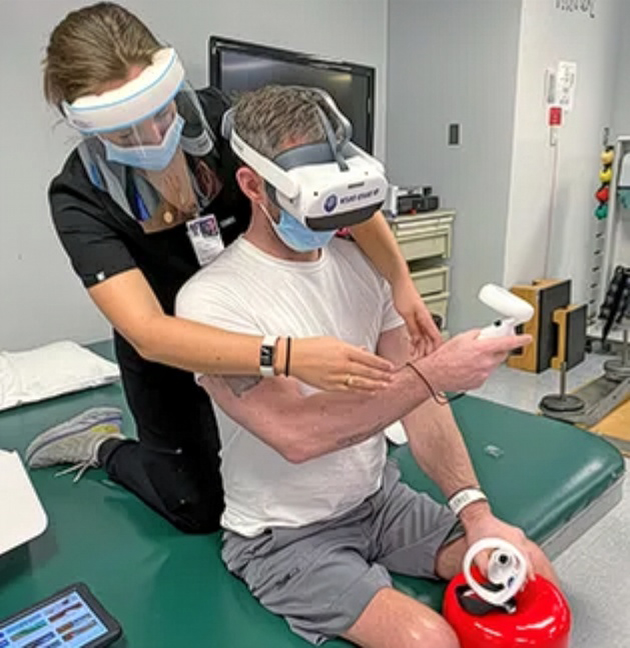
Virtual reality pain treatment expands for veterans
The Department of Veterans Affairs is expanding access to a U.S. Food and Drug Administration-authorized virtual reality (VR) therapy design

Live Whole Health #320: You deserve a break
Do you spend hours jumping between screens, messages and tasks during the day? Over time, this can make your mind tired and your body stiff.

First in VA to receive cutting-edge epilepsy treatment
A groundbreaking laser procedure offers a safer option for epilepsy treatment Back in 1980, when Robert Lindemann decided to enlist in the A