No Boots, No Problem: Ukraine captured a Russian position using only robots and drones
Try to picture an assault on a fortified trench line. FPV drones scream in first, sounding like lawnmowers from hell, cratering dugouts and scattering defenders. As the ground stops shaking, armed robots roll into the defender’s position, turrets scanning, machine guns ready. Russian soldiers burrowed in their hideouts stumble out with their hands up, surrendering to machines.
No infantry crosses the line of departure. No medevac is called. No one dies on the attacking side. The position changes hands, and no human being on the Ukrainian side was ever in danger.
On Apr. 13, 2026, Ukraine’s Arms Makers’ Day, President Volodymyr Zelenskyy confirmed what defense analysts had been tracking for months:
Ukrainian forces successfully captured a Russian-held position using only unmanned platforms, ground robots, and drones, without a single soldier’s boot physically on the assault. The Russians surrendered. Ukraine reported zero casualties.
It is the first officially recognized seizure of enemy terrain by unmanned systems in the history of this war, and almost certainly the first in any war, ever.
For The First Time In War, Drones & Ground Robotic Systems Seized Enemy positions Without A Single Soldier byu/FuneralCry- insingularity
Drones have been killing soldiers and civilians in Ukraine for years now. What makes this different is that machines didn’t just hit a target and fly home. They advanced, applied pressure, forced a surrender, and then held ground. That’s terrain seizure, and it’s the one thing that has always required boots on the ground.
Not anymore, it would seem.
Zelenskyy framed the milestone in characteristically direct terms, stating that an enemy position was taken exclusively by unmanned platforms, that the occupiers surrendered, and that the operation was carried out without infantry and without losses. He listed the robotic systems by name: Ratel, TerMIT, Ardal, Rys, Zmiy, Protector, and Volia.
Those names represent an entire combat system, not just a single weapon.
The layered system is what we call a “combat stack,” with each platform handling a specific phase of the assault. It starts with the eyes. Reconnaissance drones (Mavic and Autel quadcopters) establish persistent overhead surveillance. They find the position, map the defenses, and maintain constant visual pressure.
Every Russian soldier below knows he’s being watched, and that knowledge alone starts degrading morale.
Next comes suppressive fire. FPV kamikaze drones and the Ratel S, a wheeled kamikaze ground robot packed with antitank mines, hit bunker entrances, trenches, and defensive hardpoints. The Ratel S can carry enough explosive to crack open a reinforced dugout. Its job is not subtle; its job is violent.
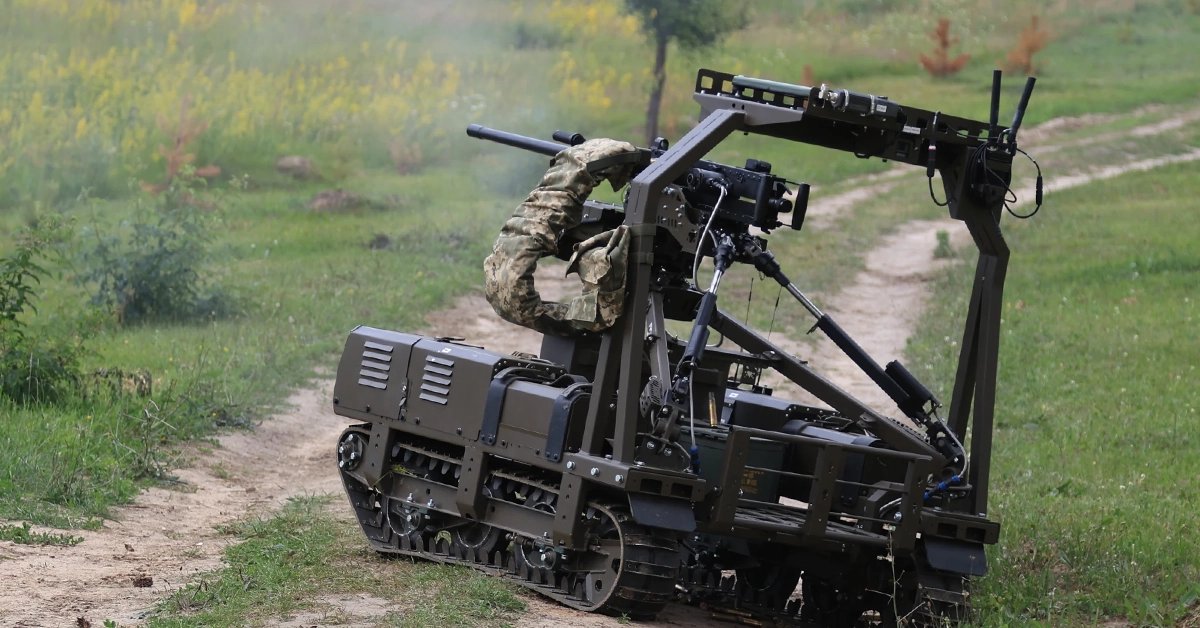
Time for the trigger pullers to move in. The Rys Pro, a multi-purpose unmanned ground vehicle equipped with a remote-controlled machine-gun turret, rolls into the trench line. The Zmiy does the same.
These are not toys; the Rys Pro mounts a 7.62mm machine gun and is operated remotely by a crew sitting safely behind cover, sometimes kilometers away. Some turrets use ballistic computers and AI-assisted tracking.
An operator sees through thermal cameras and engages targets with a precision that doesn’t degrade when the bullets start flying back.
Behind them follow the logistics platforms. TerMIT, a tracked robot capable of hauling 300 kilograms, delivers ammunition to the shooters and can evacuate wounded soldiers on the return trip. Volia does the same, with a range of up to 12 kilometers under load.
Protector, the largest of the group, recently completed testing with a Tavria-12.7 turret mounting the Browning M2 .50-caliber machine gun, giving it the firepower to engage armored vehicles and low-flying aircraft.
Layered together, it’s a full combined-arms assault conducted entirely by machines.
Zelenskyy’s April 13 statement called this “the first time in the history of this war.” But public reporting suggests earlier precedents at the tactical level. In July 2025, Ukraine’s 3rd Separate Assault Brigade reported that its drone and ground robot operators forced Russian troops to surrender in Kharkiv Oblast, entirely without infantry engagement.
FPV drones and a kamikaze ground robot carrying three antitank mines struck a bunker entrance. When a second robot approached the damaged position, two surviving Russian soldiers held up a cardboard sign reading “We want to surrender” in Russian. The brigade called it the first battlefield capitulation to robotic platforms in modern warfare.
Around January 2026, a DevDroid TW-7.62 unmanned ground vehicle captured three Russian soldiers in the Lyman area of the Ukraine front. By March, a larger cousin, the Droid TW-12.7, held frontline positions for 45 consecutive days.
So what changed on April 13? It appears that Ukraine has figured out how to develop, test, mass-produce, and deploy rapidly. Those earlier incidents were tactical, brigade-level actions, surrenders forced during robot-led assaults. This recent operation appears to be the first time Kyiv officially recognized a full position capture by unmanned systems as a war-level doctrinal milestone.
Ukraine faces acute manpower shortages along a front line stretching more than 1,000 kilometers. Meanwhile, aerial drone saturation has pushed the effective kill zone out to 20–25 kilometers from the front, making traditional infantry advances a near-guarantee of casualties.
Every soldier is a precious rarity, and Ukraine needs to protect them or risk perishing as a nation, even if they win the war on the battlefield. Every assault squad that walks into that zone risks being shredded by an FPV drone that costs less than an ok laptop.
Robots solve that equation. As Maj. Oleksandr Afanasiev, commander of the K2 Brigade’s UGV battalion, told BBC News, Ukraine can absorb the loss of robots, but it cannot afford to lose battle-ready soldiers.
Ukraine’s defense ministry reported over 9,000 UGV missions in March 2026, and nearly 24,500 in the first three months of the year. The number of military units deploying ground robots grew from 67 in November 2025 to 167 by spring 2026. One manufacturer, Tencore, delivered more than 2,000 ground robots in 2025 and projects demand of roughly 40,000 units in 2026.
Infantry is not Obsolete
Before anyone starts writing the obituary for infantry, it’s important to remember these systems are not autonomous. Remotely operated, yes, with human operators in the loop making every firing decision. Nobody should be writing “AI stormed the trench” unless they have hard evidence to back that up, and right now, no one does.
Kyiv has not yet disclosed the location or the specific unit responsible, nor has it released a full operational timeline for the April 13 mission. Russian confirmation of the event is hard to come by (for obvious reasons).
The main claim—that a position was captured by unmanned systems with zero infantry and zero casualties—comes from official Ukrainian leadership and is being corroborated by multiple outlets.
Durability is the major issue and question that remains. Robots can seize ground, sure, but holding it for extended periods raises new issues that machines still struggle with: maintenance, engineering, adaptation to changing conditions, and the hundred small decisions that an experienced squad leader makes by instinct (or pure BS).
Communications links can be jammed; if humans were easy to jam, these devices would be in every home. One weapon malfunction means the platform is useless until a human physically intervenes.
However, Ukraine has demonstrated that the most dangerous first phase of a trench assault, the part that kills the most soldiers, can now be outsourced to expendable machines. That does not eliminate infantry. It changes when and where infantry enters the fight.
Defense analysts are already calling this the new type of warfare, “Drone Wall” doctrine, a system where robotic systems handle attrition and seizure, while human soldiers are reserved for consolidation and holding on to territory.
You can bet the last of your truck’s gas money that NATO is watching this closely. Gulf states are already rushing to buy Ukrainian drone expertise, with 10-year defense cooperation agreements signed with Saudi Arabia and Qatar in March 2026.
The broader appeal and evolution are easy to see, as well. In 2024, ground robots were mostly hauling ammunition and evacuating wounded. By mid-2025, they were forcing surrenders. By April 2026, they were taking terrain and prisoners. Pandora’s box has been opened, and there’s no putting back what spews forth.
Zelenskyy, ever the communicator, put the moment in terms any soldier would understand: robots entered the most dangerous areas instead of soldiers, saving more than 22,000 lives. That’s the real headline. Not that machines took a trench, but for the first time in history, a soldier didn’t have to.
Until the next drop, stand easy.
Don’t Miss the Best of We Are The Mighty
• Flintlock to firepower: The grunt’s 250-year quest for a weapon that actually works • A salute to assistant gunners and ammo bearers: the invisible half of every gun • SMASH2000: Finally, an AI-powered optic that turns your AR-15 into a drone hunter
The iconic Colt Detective Special was America’s concealed carry of choice from World War II to Vietnam
The pros and cons of the Army’s new rifle and machine gun
This one fix could make the M4 a near-perfect carbine
How the fastest manmade object ever was once a manhole cover launched by a nuke
SMASH2000: Finally, an AI-powered optic that turns your AR-15 into a drone hunter