The Iran war took a toll on the Air Force’s Reaper fleet
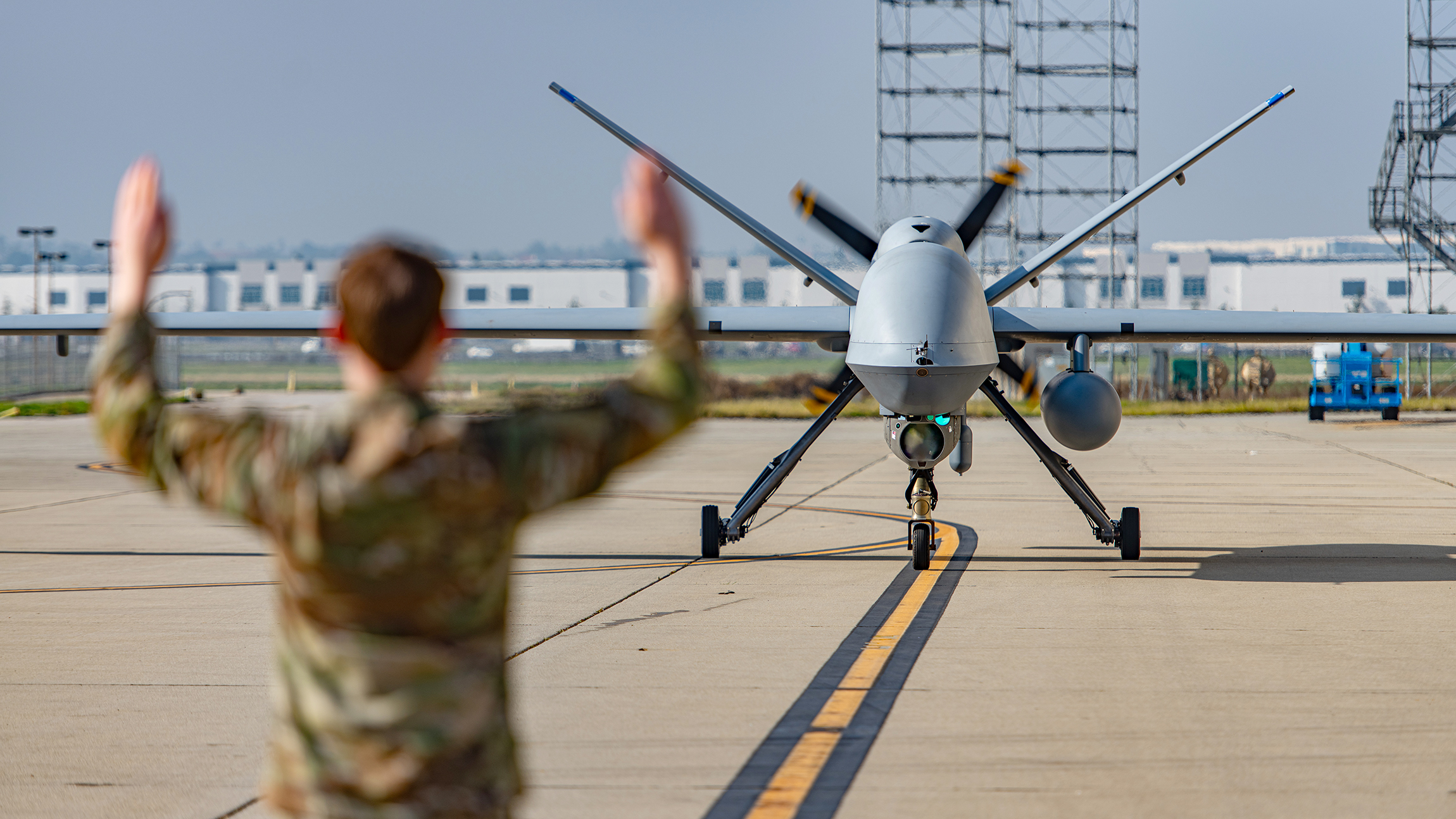
The MQ-9 Reaper, a staple for the U.S. since the turn of the 21st century, has remained a go-to asset for the military, even as recently as the war with Iran.
But over the last few years, the U.S. has lost at least 35 Reaper drones — at least 16 were downed over Iran, 7 were shot by the Houthis in Yemen in Spring 2025, and 12 from other aircraft accidents recorded by the Air Force.
Retired Air Force Brig. Gen. Houston Cantwell, who spent two years overseeing a unit of drone pilots out of Creech Air Force Base in Nevada, and two years training future drone pilots at Holloman Air Force Base in New Mexico, said the impact on the Air Force’s Reaper fleet is “a big deal.”
“That is a significant percentage of the fleet, and there is no other aircraft that is positioned and ready to assume the responsibilities that the MQ-9 has across multiple combatant commands,” Cantwell said. “And right now, there’s no plan to backfill all these aircraft being shot down.”
According to Air Force accident reports going back to 2021, 12 Reapers have been lost to non-combat accidents. Investigators have linked the causes of those accidents to mechanical failures — like one where an aircraft propeller came off mid-flight over the Mediterranean Sea in 2024 — and others to mistakes by pilots.
General Atomics built 575 Reapers for the U.S. over the program’s lifetime, according to the company. The MQ-9A is flown by the Air Force, Marine Corps, Air National Guard, and the Department of Homeland Security. As of September 2024, the Air Force had 230 Reapers, the lion’s share of the U.S. military’s Reaper fleet.
Air Force officials referred Task & Purpose questions about Reaper combat losses over Iran to U.S. Central Command, which declined to comment.
“Each mission provides an opportunity to learn, and we incorporate that feedback continuously,” according to Mark Brinkley, a General Atomics spokesman. “All aircraft are vulnerable, such is the nature of flight, but Reaper opens up a series of options unlike anything else in the arsenal.”
Top Stories This Week
A boom operator on an Air Force tanker earned two DFCs for combat flights
By Nicholas Slayton, Matt White
Army lets soldiers deployed for Operation Epic Fury reenlist two years early
Two destroyers cross Strait of Hormuz ahead of mine clearance mission
The dollar value of each Reaper is hard to pin down. A Congressional Research Service report estimated each aircraft at $28 million. An Air Force press release from 2020 announcing a contract with General Atomics estimated that each Reaper costs around $16 million, a price the company confirmed to Task & Purpose. Air Force accident reports cited Reaper losses costing between $13 million to $26 million, but many aircraft were valued at around $16 million.
Based on those ranges, Reaper losses in recent combat have cost the U.S. anywhere from $300 million to just under $600 million.
Risking drones rather than manned aircraft
The MQ-9’s ability to fly continuously for over 24 hours and carry multiple payloads is unmatched by any other single system — two major capabilities that have kept the relatively large drones relevant amid the exploding market of small drones, Air Force reconnaissance experts told Task & Purpose.
During operations against Iran, Reapers appeared to film U.S. strikes on Iranian aircraft, drones and missile launchers and may have even been tasked overhead during the recovery of a downed F-15E pilot. The Air Force has also signaled a continued interest in the platform, reactivating dedicated Reaper units in the U.S. and overseas.
The U.S. still finds occasion to turn to the MQ-9s over human pilots because of the safety and cost considerations, said Cantwell, who noted that flying fighter jets costs between $5,000 to $40,000 an hour and is a “logistical nightmare” with air tankers and coordination.
As the U.S. learned in early April after two F-15 fighter jets were shot down over Iran, rescue missions can also be incredibly risky and involve a lot of moving parts. President Donald Trump told reporters that the daring mission involved 68 fighters, 48 aerial tankers, 13 rescue aircraft, and four bombers. During the rescue operation, the U.S. lost two U.S. Special Operations MC-130J aircraft, each totaling over $100 million. The downed F-15E cost more than $31 million (based on 1998 prices).
“Have these robot planes get shot down. I’d much rather have that than having, according to the president, 100 aircraft take off to go rescue one pilot. We can’t do that every day,” said Cantwell, now a senior fellow at the Mitchell Institute for Aerospace Studies. “Send in the MQ-9s every day, twice on Sunday.”
Future of the fleet
The aircraft lost in combat and accidents in recent years come after the Air Force ended production of the MQ-9A in 2020. Air Force officials cited shifting priorities for combatting near-peer adversaries, like Russia and China, which took General Atomics officials by surprise.
The company has since developed a new version, the MQ-9Bs, nicknamed “SkyGuardians,” which cost roughly $30 million apiece and have upgrades for flying in all types of weather, detection and avoidance capabilities, anti-collision warnings, and can carry bigger payloads.
MQ-9Bs have been purchased by Air Force Special Operations Command and the Department of Homeland Security, but “no individual military service has announced any production contracts for MQ-9Bs,” General Atomics officials said.
General Atomics sells self-protection pods for the MQ-9, which the company purports can mitigate against surface-to-air threats and infrared and radio frequency threats. Cantwell said these options include flares to decoy infrared missiles, chaff or pieces of aluminum that deflect radar tracking, and electronic emitters to jam and deceive enemy radars.
“Until now, no one has ever felt that it was worth the investment, so we’ll see if that changes after this conflict,” Cantwell said.
CORRECTION: 4/13/2026; An earlier version of this article inaccurately stated that 70 Reapers fly 500,000 miles around the world each year. That number applies to all General Atomics aircraft, not just the MQ-9 Reaper.