The US Navy’s first submarine was a hand-cranked wooden egg
The American Revolution was not only a political and military struggle for independence. It was also a period of remarkable experimentation. Faced with a global empire and an unmatched navy, the American colonies relied on ingenuity as much as courage. Among the most daring and imaginative creations of that era was a small wooden submarine built by David Bushnell in 1775.
Bushnell’s craft, known as the Turtle, was the first combat submarine in world history. Though it failed to sink a British ship, its design and concept marked the beginning of undersea warfare.
Over the next 200-plus years, submarine technology evolved from hand-cranked wooden vessels to nuclear-powered machines capable of remaining submerged for months and traveling across the globe undetected.
The story of the submarine mirrors the broader story of the United States itself. It is one of experimentation, persistence, and transformation. As the nation celebrates its 250th anniversary, the journey from the Turtle to modern submarines offers a powerful lens through which to examine American innovation and determination.
In 1775, the American colonies faced a formidable adversary. The British Royal Navy controlled the seas, blockading ports and transporting troops with ease, and the Continentals had little hope of matching British naval power through conventional means. American leaders encouraged creative solutions that could offset British advantages. It was in this environment that Bushnell conceived his revolutionary underwater craft.
Bushnell was a Yale-educated inventor fascinated by mechanics and buoyancy. He believed that a submersible vessel could approach an enemy ship undetected to attach an explosive charge beneath its hull. This idea was radical in the 18th century. Ships were thought to be safe from attack below the waterline. Bushnell aimed to challenge that assumption.
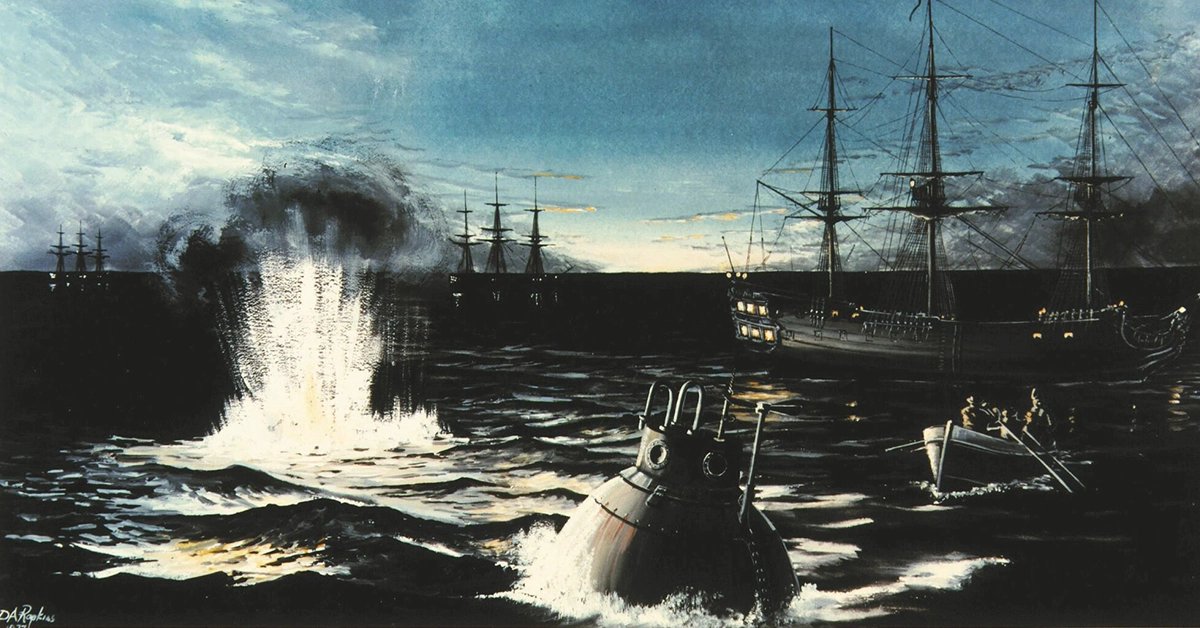
The Turtle was constructed from oak timbers and sealed with pitch and tar to create a watertight hull. Its shape resembled an upright egg or acorn. It stood roughly seven feet tall and just wide enough to hold a single operator. Inside the cramped interior, the pilot sat upright and operated a series of hand-cranked mechanisms. There were no engines or motors. The submarine moved only through human effort.
Carrying a Gunpowder-Filled Mine
Bushnell incorporated several innovations that later became foundational to submarine design. The Turtle used ballast tanks to control buoyancy. Water could be admitted into a chamber to allow the craft to sink and pumped out to allow it to rise. This principle remains central to submarine operations today.
The Turtle also employed screw propellers for propulsion. One propeller provided forward motion, while the other controlled vertical movement. These hand-cranked propellers were among the earliest examples of screw propulsion used in a military context.
The submersible’s weapon was a timed mine filled with gunpowder. Bushnell referred to it as a torpedo, though it functioned more like a detachable explosive charge. The operator maneuvered beneath a British ship, drilled a screw into its hull, and attached the mine. A timer then detonated the charge after the submarine had retreated.
The concept required exceptional precision and endurance from the operator.
Despite its ingenuity, the Turtle had severe limitations. It could remain submerged for only about 30 minutes before the air supply ran low. Steering required constant manual effort. Visibility was limited to small viewing ports and faint instrument lighting. Operating the submarine demanded physical strength, coordination, and calm under pressure.
Yet even with these limitations, Bushnell’s invention represented a remarkable leap forward. It introduced the idea that naval warfare could occur beneath the surface of the sea. The Turtle demonstrated that controlled submersion and underwater navigation were possible. It challenged assumptions about naval security and opened the door to new forms of attack.
The First Combat Mission in New York Harbor
The Turtle’s most famous mission took place in September 1776 during the British occupation of New York Harbor. The Continental Army sought a way to disrupt British naval operations and boost morale. Sgt. Ezra Lee volunteered to pilot the experimental craft in an attempt to attack the British flagship HMS Eagle.
Under the cover of darkness, Lee navigated the Turtle through the harbor. The task was highly difficult. Currents, tides, and limited visibility made maneuvering challenging. Nevertheless, Lee managed to approach the British ship undetected.
He tried to drill into the hull to attach the explosive charge, but he encountered an unexpected obstacle. British warships often had copper sheathing below the waterline to protect against marine growth and damage. The Turtle’s drill could not penetrate this metal layer.
Lee made repeated attempts but eventually abandoned the mission. The British spotted him, and he was forced to detonate the mine to make his escape. Although the attack failed, it demonstrated that a submarine could approach an enemy vessel without detection. It also revealed technical challenges that informed future designs.
The attempt startled the British. The idea of a submarine attack seemed almost fantastical. Some sailors reportedly referred to such devices as “infernal machines.” But even in failure, the Turtle proved that underwater warfare was possible and hinted at its potential.
The Turtle saw limited additional use during the Revolutionary War and was eventually lost. Yet its legacy endured. It had introduced key engineering principles and demonstrated the feasibility of undersea attack. It marked the beginning of a technological journey that continued for centuries.
Civil War Advances and the Rise of the Hunley
Nearly a century later, the U.S. again turned to submarine technology during the Civil War. The Confederacy faced a powerful Union naval blockade that restricted trade and supplies. In response, Confederate engineers developed experimental subs in hopes of breaking the blockade.
The most famous of these was the H.L. Hunley. Named after its designer, Horace Hunley, this submarine was longer and more streamlined than the Turtle, allowing for greater speed and stability. Instead of a single operator, it required a crew of eight men who turned a hand-cranked propeller along the vessel’s length.
The Hunley used ballast tanks and pumps similar to those that Bushnell pioneered. It could submerge and surface through controlled water intake and release. The submarine also featured systems for air intake when near the surface. Though still primitive, these improvements made it more capable than earlier designs.
Its weapon system differed from the Turtle’s mine attachment method. The Hunley carried a spar torpedo, an explosive charge mounted on a long pole extending from the bow. The crew rammed the charge into an enemy ship and then detonated it after backing away. This approach removed the need to drill into a hull.
On Feb. 17, 1864, the Hunley attacked the Union warship USS Housatonic near Charleston, South Carolina. The sub successfully detonated its explosive and sank the ship. This marked the first time a submarine destroyed an enemy warship in combat. However, the victory came at a high cost. The explosion killed the Hunley’s crew. The submarine sank soon after the attack and remained lost for more than a century before being recovered.
The Hunley proved that underwater attack could be effective while also highlighting the risks faced by early submariners. Yet it remained limited by manual propulsion and fragile construction.
Industrial Progress and the Diesel Electric Era
The late 19th and early 20th centuries brought rapid advances in engineering and propulsion. Submarines began to evolve from experimental craft into practical naval weapons. The most significant breakthrough came with the development of diesel-electric propulsion systems.
These submarines used diesel engines for surface travel and for charging batteries. When submerged, they switched to electric motors powered by stored energy. This system allowed for longer missions and quieter underwater operations. Submarines could now travel thousands of miles and remain at sea for extended periods.
During World War I, German U-boats demonstrated the strategic potential of submarines. They targeted merchant shipping and naval vessels, disrupting supply lines and altering the course of the war. By World War II, submarines had become central to naval strategy on both sides of the conflict.
American submarines in the Pacific targeted Japanese shipping and played a crucial role in weakening Japan’s war effort. German U-boats in the Atlantic threatened Allied convoys and forced the development of anti-submarine tactics. Submarines were no longer experimental. They were decisive weapons capable of shaping entire campaigns.
Technological improvements continued. Sonar systems enhanced detection and navigation. Self-propelled torpedoes replaced earlier mines and spar weapons. Snorkels allowed submarines to run diesel engines while submerged at shallow depth. These advances increased stealth and endurance.
Compared to the Turtle, diesel-electric submarines represented a massive leap forward. They carried crews of dozens, traveled across oceans, and operated for weeks. Yet they still relied on ballast systems, propellers, and stealthy approach tactics rooted in Bushnell’s original design.
The Dolphin and the Silent Service
Within the U.S. submarine force, tradition and symbolism play an important role. One of the most recognizable symbols is the dolphin, which serves as the unofficial mascot of the submarine community. The dolphin appears on submariners’ qualification insignia and represents heritage and identity.
Dolphins are intelligent marine mammals known for their ability to navigate and communicate underwater. They use echolocation to detect objects and orient themselves in the ocean. These qualities mirror the skills required of submariners, who rely on sonar, navigation systems, and teamwork to operate beneath the sea. The dolphin symbolizes awareness, precision, and adaptability.
Earning the right to wear submarine dolphins is a significant milestone for sailors. It requires extensive training and mastery of submarine systems. Once qualified, a submariner becomes part of a close-knit community often referred to as the silent service. The dolphin insignia represents competence, trust, and shared responsibility.
The dolphin also reflects the cooperative nature of submarine crews. Dolphins travel in pods and rely on teamwork for survival. Submarine crews, likewise, must function as cohesive units in confined spaces. Every member plays a critical role in maintaining the vessel and completing missions. The dolphin mascot captures the spirit of intelligence, teamwork, and resilience that defines the submarine force.
The submariner’s legacy begins with a small wooden craft powered by human effort and guided by bold imagination. It eventually evolved into the nuclear-powered submarines of the modern era.
As the United States celebrates its 250th anniversary, this technological evolution reflects the nation’s inventive spirit. The Turtle did not sink a British ship, but it introduced ideas that changed naval warfare forever. Each generation built upon those ideas, transforming a fragile experiment into one of the most powerful tools of modern defense.Don’t Miss the Best of We Are The Mighty
• The ship that delivered the atomic bomb was sunk, and nobody came to look for it • 25 incredible photos of life on a US Navy submarine • A Medal of Honor recipient used a dud enemy mortar to save US troops during WWII
How to join the National World War II Museum’s celebration for ‘Band of Brothers’ 25th annivesary
No Boots, No Problem: Ukraine captured a Russian position using only robots and drones
The US Navy’s first submarine was a hand-cranked wooden egg
By Daniel Tobias Flint
Some military forces call autism a disqualifier. The IDF calls it an advantage.
World War II
A Nazi was the only person convicted of spying in connection with Pearl Harbor